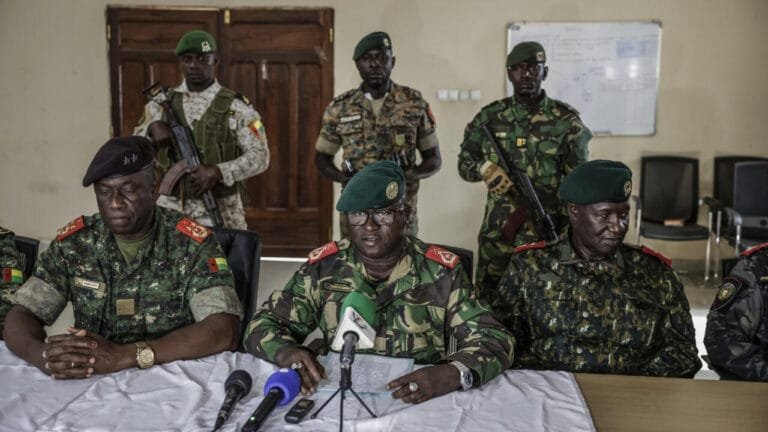
Guinea – A Guinean army officer announced on state television Wednesday the removal of President Umaro Sissoco Embaló and the suspension of state institutions “until further notice.” This marks a sudden escalation of the political crisis that preceded the announcement of the preliminary results of Sunday’s presidential election.
These developments come as the capital, Bissau, is experiencing unprecedented security tensions amid a heavy deployment of army forces.
Heavy gunfire was heard in the vicinity of the presidential palace and the headquarters of the National Election Commission early Wednesday morning, according to local residents and journalists from Agence France-Presse and Reuters.
Witnesses confirmed that several passersby fled for shelter after hearing gunfire. Armed clashes continued near the two headquarters until approximately 13:00 GMT.
The electoral commission was scheduled to announce preliminary results on Thursday. Incumbent President Umaro Sissoco Embaló was running against his main rival, Fernando Dias. However, the military’s sudden intervention led to the “complete suspension of the electoral process,” according to a brief statement from the military, which declared it had taken “full control” of the country.
Guinea-Bissau is one of the most politically fragile countries in West Africa. Since gaining independence from Portugal in the 1970s, it has experienced a long series of coups, attempted rebellions, and conflicts within the army.
Power struggles have become frequent due to the conflict between the presidency, the military, and political parties, as well as mutual accusations of foreign interference and corruption. It remains unclear who is responsible for the shooting. It is also unknown whether President Embaló is still in the country or who is actually leading the military action. This is all happening in the absence of any official statement from the presidency or the government.
Regional and international organizations are closely monitoring the situation amid fears that the country could slide into a new wave of instability.