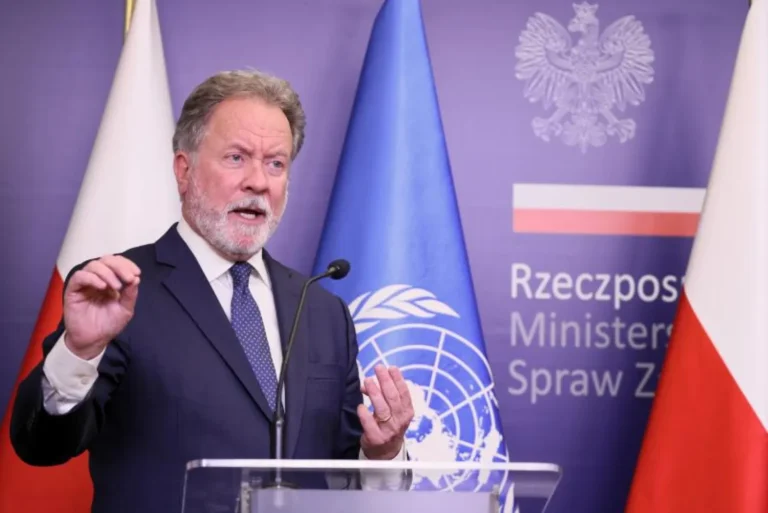
Former UN World Food Programme executive David Beasley said the world has enough food and funding to end hunger.
But humanitarian efforts continue to fail because decision-makers benefit
from short-term solutions that perpetuate crises instead of addressing their root causes.
Beasley, who has witnessed firsthand the greatest humanitarian crises in Yemen,
Syria, Afghanistan and Gaza, pointed out that food is not just a means of survival;
Rather, it is a factor that creates or destroys stability,
and can be the dividing line between peace and war.
Certificates from the field of work
In an article for the American newspaper, The New York Times,
he recounted testimonies from the field of humanitarian work.
Among them was a mother who told him that her son did not
want to join ISIS or al-Qaeda, but did so in order to feed his daughter.
These stories, he says, illustrate how hunger drives people to desperate choices.
Beasley argues that the fundamental problem lies
in the world’s treatment of famine as a separate event.
While it is linked to a series of crises that include conflicts, corruption,
and the collapse of economic systems.
A weapon for peace
He asserts that the current aid model addresses the symptoms, not the causes,
leading to the same cycle repeating itself year after year.
It is worth noting that the World Food Programme received the Nobel Peace Prize in 2020.
In recognition of his efforts in transforming food into a “weapon for peace,”
by promoting reconciliation and stability in affected communities.
As he explains, food has the same power to create peace or ignite conflict.
This is why some regimes use it as a weapon to weaken and control the population.
Hunger… the most dangerous force
Beasley asserts that hunger—not food—is the most dangerous force.
Because it drives people to the brink of despair. The scenes of displacement
from Gaza, Sudan, and Yemen reflect a bitter reality:
Millions risk their lives for a morsel of food or a single bag of flour.
He explained that ending hunger requires political will to address
the root causes of poverty and inequality.
Instead of temporary solutions that guarantee the continuation of suffering.