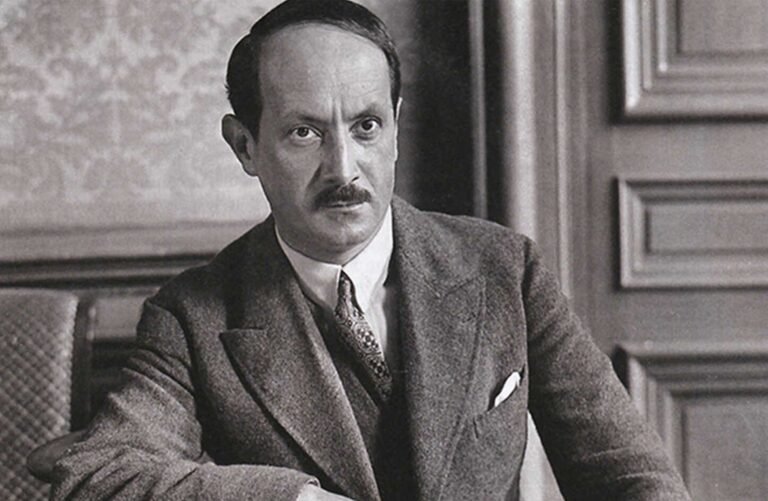
Paris – France — Saint-John Perse is universally recognized as one of the most prominent and profound luminaries of 20th-century French literature. He stands as an exceptional, strategic figure who masterfully balanced high-level diplomatic statecraft with deep, philosophical poetic innovation. He left behind a rich literary domain that continues to captivate critics and researchers worldwide, having successfully transmuted his experiences in global politics, forced exile, and geographical wandering into authoritative poetic texts that secured him a revered position in world literature, culminating in the Nobel Prize in Literature.
From Caribbean Tropics to the Geopolitical Machinery of Paris
Born Saint-John Perse—whose civilian name was Alexis Saint-Leger Leger—in 1887 on the French island of Guadeloupe in the heart of the Caribbean, he grew up immersed in a vibrant ecosystem of cultural diversity and raw, majestic nature. The panoramic ocean views, vast open spaces, and lush tropical flora of his formative years left an indelible imprint on his subsequent poetry, acting as a permanent wellspring for the visual metaphors, symbols, and structural imagery in his writings.
Upon relocating to France, he pursued rigorous studies in law and political science before formally entering the French diplomatic corps. This marked the inception of a stellar, rapidly ascending career that propelled him into highly influential and sovereign positions within the Ministry of Foreign Affairs in Paris. Throughout his years of state service, he actively participated in drafting pivotal international policies and managing complex diplomatic portfolios, acquiring comprehensive expertise in foreign relations that placed him at the immediate center of European decision-making during an epoch defined by cascading political upheavals.
The Literary Alter Ego and the Grand Epic Scope
Despite being heavily consumed by official state duties and international crisis management, Saint-John Perse never abandoned his foundational passion for literature. He continuously composed poetry under a carefully guarded pseudonym (Saint-John Perse) to keep his creative output distinct from his official diplomatic identity. His writings quickly arrested the attention of the cultural avant-garde due to a highly distinct rhetorical style that blended elevated language with existential philosophy and an expansive anthropological imagination. He boldly rejected traditional poetic meters and stanzas, delivering long prose-poems characterized by a sweeping epic scale that investigated humanity, civilization, the philosophy of power, existence, and the supremacy of nature.
With the outbreak of World War II and the sudden fall of France to Nazi occupation, his professional and political life experienced a violent, systemic dislocation. Stripped of his diplomatic rank by the Vichy regime, he was forced into political exile, eventually settling in the United States for many years. This marked a challenging new chapter characterized by psychological displacement and alienation—a harrowing experience that left a profound mark on his literary production, infusing his poetry with a vast, universal humanitarian dimension.
An American Exile Crowned with the Nobel Prize
In his American displacement, Saint-John Perse sustained his creative output and cosmic contemplation, publishing a series of rare masterpiece volumes that firmly cemented his status among the world’s elite poets and philosophers. His verses navigated the themes of departure, identity, displacement, and the arduous search for existential meaning, while simultaneously celebrating the resilient capacity of human civilizations to transcend historical catastrophes and the structural shifts of history.
In 1960, his literary journey reached its historical apex when he was awarded the Nobel Prize in Literature. The Swedish Academy highly lauded the soaring power of his verse, the linguistic wealth of his epics, and the far-reaching scope of his humanitarian vision. His victory was universally celebrated as a global acknowledgment of a unique creative trajectory that seamlessly blended culture, history, and geopolitics into an elevated poetic matrix that dissolved national and linguistic boundaries.
Literary theorists frequently label Saint-John Perse as the “Poet of the Perpetual Journey,” referencing not only his physical migrations across the Caribbean, Europe, and America, but also his continuous intellectual and spiritual odyssey through the core dilemmas of human existence. His compiled works represent an epistemological crusade to decipher the world and its structural transformations, a quality that lends his texts a timeless, global resonance. As the archetype of the polymath intellectual who fused diplomatic sagacity with pure creative genius, he transformed the bitterness of exile into a pristine source of inspiration, leaving behind a literary legacy that continues to inspire contemporary generations of poets and writers across the globe.