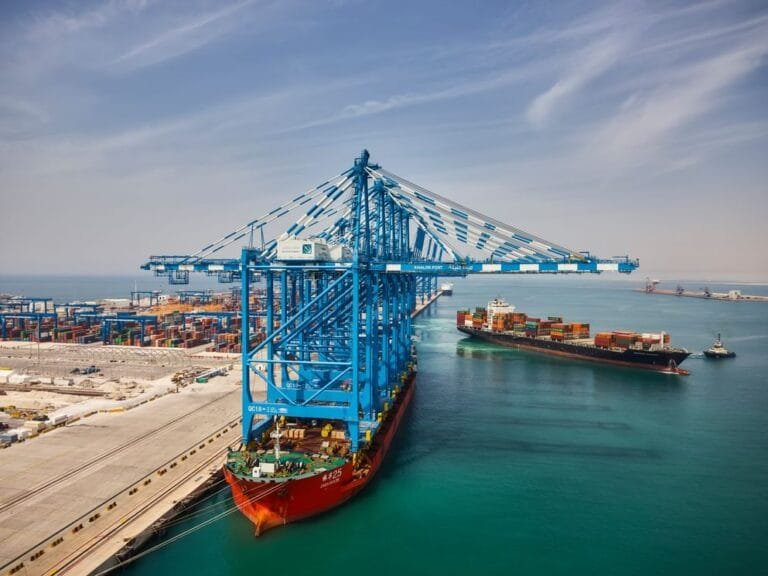
Abu Dhabi, UAE – Abu Dhabi Ports Group’s revenues grew by 25% year-on-year to reach AED 5.75 billion during the first quarter of 2026. Through full organic growth driven by the strong operational and financial performance of the maritime and shipping sector, and the economic cities and free zones sector.
The group’s earnings growth momentum accelerated before interest, taxes, depreciation and amortization, by 33% year-on-year. To reach AED 1.52 billion, driven by improved profitability, as profit margin before deducting interest, taxes, depreciation and amortization rose to 26.4% during the first quarter of 2026. Compared to 24.7% during the same period of the previous year.
Flexibility of the trading system
The group’s total net profits jumped by 41% year-on-year during the first quarter of 2026, reaching AED 653 million. Driven by operational efficiency, lower financing costs, and increased contribution from joint ventures and associates.
The group’s financial results reflect the flexibility of its integrated and diversified business system. Amidst a geopolitical and macroeconomic landscape full of challenges and complexities.
In terms of services and geographical scope, the group has proven through its diverse operations and integrated business model based on long-term partnerships and contracts. Its clear strategy and operational flexibility mean that it is once again able to transform risks and challenges into diverse opportunities.
In light of the current geopolitical challenges in the Arabian Gulf region, the group has been able to maintain the continuity of its services and operate normally. Activating crisis management and business continuity procedures as a precautionary measure.
New regional shipping services
Business continuity measures included redirecting shipping operations and regional shipping services to the ports of Fujairah and Khorfakkan Port. Activating new land and air bridges, supported by additional warehouse and storage facilities.
The group also launched new regional shipping services to maintain the flow of supply chains, while redeploying and expanding the fleet of container ships and bulk cargo. He developed plans to further increase the fleet’s capacity. New services have been launched to strengthen the network with ports in India, Pakistan and Oman. In addition to the ports of the Red Sea and the ports of the Upper Arabian Gulf.
The group activated a land bridge to transport goods from Fujairah and Khor Fakkan through safe customs corridors through the UAE to Khalifa Port, Jebel Ali Port and Sharjah. Using 800 trucks, and four new daily rail services via Union Trains.
These efforts have been complemented by the group’s storage and warehouse capabilities for essential goods, which currently extend over an area of more than 76,000 square meters. With plans to increase the storage area to 188,000 square metres.
Rising regional shipping volumes
In the maritime and shipping sector, the strong performance was due to the combined effects of handling volumes and prices. Especially in regional container shipping services, ro-ro vessels, and tankers, in addition to increasing dry dock activities.
Regional container shipping volumes increased by 20% year-on-year to reach 871,000 TEUs in the first quarter of 2026. Driven by increased services and capacity, the fleet of bulk, multi-purpose and roll-on/roll-off cargo vessels reached 63, compared to 41 during the same period the previous year.
In the economic cities and free zones sector, growth momentum continued with the signing of new industrial land lease contracts, which led to the addition of a net area of 843,000 square meters in Kizad Abu Dhabi. Which generated strong demand for warehouses, employee housing and service facilities.
Kizad also completed the sale of a group of warehouses to the Mir Group, valued at AED 295 million. It sold a mixed-use plot of land with an area of 1.0 square kilometers to Danube Real Estate Company for a value of 840 million dirhams. This is within the framework of the Group’s strategy for actively managing its asset portfolio across all business sectors. Liquidating non-core real estate assets when appropriate opportunities become available.
Increase in port capacity
In the ports sector, operations in the UAE have maintained their flexibility despite regional challenges. Quarterly container handling volumes decreased by 5% year-on-year. General cargo handling volumes declined by 23% year-on-year, largely offset by strong growth in international handling volumes of 17% and 21%, respectively.
In the UAE, container capacity utilization reached 54%, compared to 57% at Khalifa Port. While internationally it reached 65%, high compared to 58% in the first quarter of 2025.