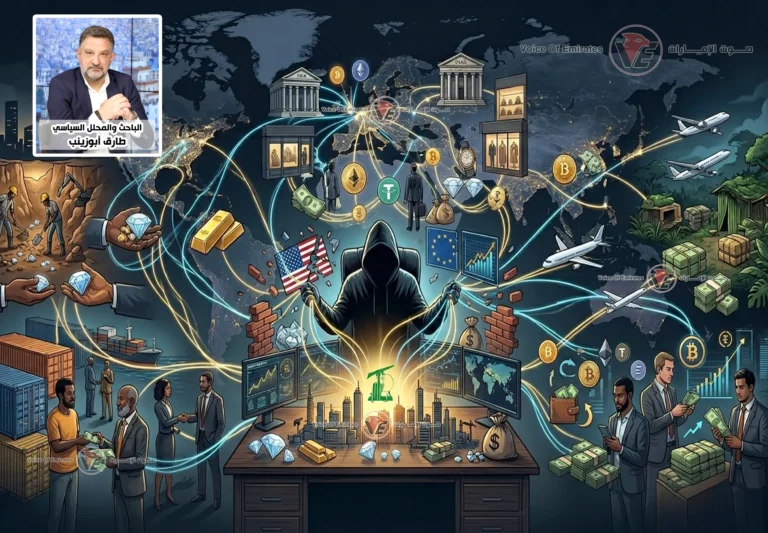
Exclusive, Voice of Emirates – In an in-depth analytical reading of the issue of financing armed groups, researcher and political analyst Tariq Abu Zeinab confirmed in an exclusive statement to Voice of Emirates that the Lebanese Hezbollah has succeeded in building a “transcontinental” financial system that operates as a parallel lifeline, independent of direct Iranian support.
Abu Zeinab explained that these networks have become a complex security and financial challenge for the international community in 2026.
Africa and Latin America: A dangerous funding triangle
Abu Zeinab pointed out that the African market has emerged as a major source of financing,
exploiting the extensive commercial reach of the Lebanese diaspora there.
He explained that the activity is not limited to traditional trade, but extends to include:
The diamond and gold trade: using precious metals as vehicles for preserving value
and transferring it beyond the reach of banking oversight.
The car and real estate trade: complex investment fronts for money laundering and profit recycling.
The drug cartel: Abu Zeinab revealed a dangerous overlap with cocaine networks in Latin America (especially Colombia),
where shipments are transported to Europe and the profits are converted into luxury goods before being sent to Lebanon.
The digital revolution in the service of “secret finance”
In a notable technological development observed by Abu Zeinab,
he confirmed that the party has shifted from traditional methods to cryptocurrencies (stablecoins).
He stated, “By 2026, the use of digital systems will become a primary means
for the party to circumvent the global banking system (SWIFT),
making it difficult to trace and dismantle financial networks.”
He also pointed out the continued reliance on institutions like “Al-Qard Al-Hasan”
as a de facto central bank operating outside the sovereignty of the state and international law.
Violation of Lebanese sovereignty and passports
Abu Zeinab warned of “extremely dangerous” security implications, pointing to the use of Lebanese passports
by members of the Iranian Revolutionary Guard Corps, facilitated by networks linked to Hezbollah in Africa.
He emphasized that this security breach goes beyond mere funding, reaching the point of threatening the security of host countries.
It also damages the international reputation of Lebanese official documents.
Europe: The most prominent arena for money laundering
Based on the latest reports issued in April 2026, Abu Zeinab revealed that 30% of Hezbollah’s budget is now laundered
in European markets through the purchase of luxury goods, watches, and artwork.
He specifically named Adham Tabaja, Mohammad Bazzi, and Nazem Ahmad as key figures in this network,
all of whom are subject to international sanctions.
Summary of the situation: An international blockade is expected
Tariq Abu Zeinab concluded his statement to “Voice of Emirates” by emphasizing that the next phase will witness “unprecedented tightening,” saying:
“We are facing a parallel economy that blends organized crime with modern financial technologies,
which necessitates high-level international intelligence and financial coordination
to dry up these sources that threaten regional and international stability.”
He explained that Washington and European capitals are moving towards imposing strict measures, including:
1- Pressuring African banks to prevent the processing of any suspicious transactions.
2- Closing legal loopholes in anti-money laundering laws related to digital currencies.
3- Expanding sanctions lists to include intermediary commercial entities that act as fronts for the party.