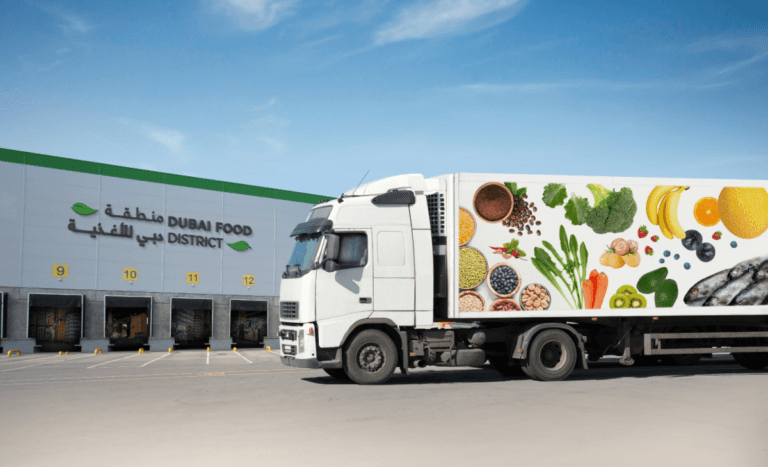
Dubai, UAE – The General Manager of the Dubai Food Zone at DP World (DB World), Ramzi Kahil, stated that the Dubai Food Zone project is one of the strategic projects of the Dubai government.
It constitutes a fundamental pillar in supporting the emirate’s food security strategy and enhancing the flexibility of food supply chains.
He added that the project is scheduled to begin in 2027, with development work taking between one and two years.
To be ready to receive customers and the public as soon as it is completed.
Kahil stressed that «Dubai Food Zone represents an integrated market for food trade and circulation, which is being developed based on the current market in the Al Owayr area (fruit and vegetable market)».
He explained that the market is planned to include broader types of food products in the future, such as meat, dairy, grains, and basic food commodities.
In addition to specialized and luxury products.
He pointed out that the project is a strategic opportunity for the Emirate of Dubai, as it allows DP World Group to redevelop the existing market in Al Owair by expanding the area to approximately 29 million square feet.
This enhances Dubai’s position as an advanced global center for food trade and related logistics services.
He explained that the volume of food trade in the UAE market amounts to about 2.3 million tons annually, with plans to raise this number to more than three million tons in the coming years.
Reflecting the expected growth in food trade regionally and globally.
Kahil stressed that the project will contribute to consolidating Dubai’s position on the map of global markets.
He pointed out that the development of the Dubai Food Zone will make the Dubai market among the best in the world in the field of food trade and handling.
Kahil pointed out that the project, as part of Dubai’s D33 economic agenda, contributes to consolidating the emirate’s position as a global gateway for food trade in the Middle East and North Africa region.
This is done by enhancing the flexibility of supply chains and linking them to global trade networks.
He said that «the project is directly consistent with the National Food Security Strategy 2051.
It transforms it from a legislative framework into tangible operational capabilities, through an advanced infrastructure that includes integrated facilities for refrigeration, processing, logistics services, and digital systems».
regional centre
He also stressed that the project supports the UAE’s role as a regional centre for food redistribution.
It also promotes trade diversification by supporting comprehensive economic partnership agreements, by providing the necessary infrastructure for food trade corridors.
He pointed out that the project provides broad opportunities for small and medium-sized companies operating in the food sector.
It gives it access to advanced institutional-style infrastructure without the need for large capital investments.
This is done by taking advantage of shared facilities for cooling, processing and distribution, converting fixed costs into flexible operating expenses.