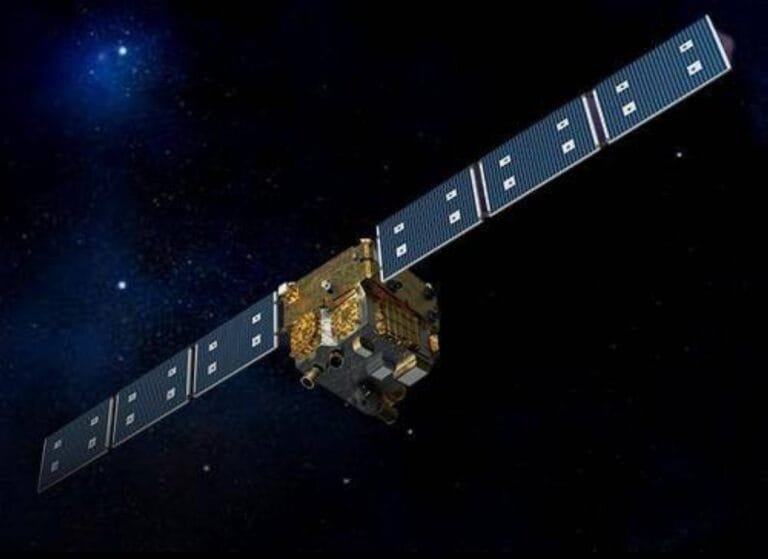
Dubai, United Arab Emirates – The Emirates Space Agency announced that the Arab satellite 813 is ready to be launched and operate in orbit with high efficiency and reliability.
It successfully passed the Launch Readiness Review (FRR) and Operational Readiness Review (ORR) phases.
The agency explained that the completion of the project embodies the capabilities of the National Center for Space Science and Technology at the United Arab Emirates University.
All tests were carried out using a national infrastructure and with the efforts of specialized Emirati competencies.
Which reflects the technical and scientific progress achieved by the country in the field of space.
The agency indicated that the launch of the Arab satellite 813 constitutes a new phase of Arab space cooperation.
It will provide high-resolution spectral data, which will support governments, researchers and institutions in the Arab world in developing innovative solutions.
In addition to making decisions based on accurate data.
In a way that contributes to enhancing sustainability and enabling development based on space knowledge and technology.
Project 813 is considered the first project in cooperation with Arab countries led by the United Arab Emirates.
Emirati gift
This comes after Sheikh Mohammed bin Rashid Al Maktoum, Ruler of Dubai, directed and announced the project as a gift to the Arab Space Cooperation Group at the World Space Conference (Abu Dhabi, March 2019). This is on the occasion of the signing of the charter establishing the Arab Group for Space Cooperation.
This initiative came as actual support from the wise leadership to launch the group and pool Arab energies in the field of space.
The new satellite was named “813” after the year that witnessed the beginning of the prosperity of the House of Wisdom in Baghdad during the reign of Caliph Al-Ma’mun.
Referring to the golden age of science and knowledge in Arab-Islamic civilization.
The UAE Space Agency funded and supervised the project, while the National Center for Space Science and Technology at the UAE University is leading the implementation process.
The Arab satellite 813 is one of the distinguished spectral satellites in terms of weight, size and efficiency.
The agency was keen to ensure that it was manufactured within the country through scientific centers and local laboratories.
With the aim of qualifying Arab cadres in the fields of design, manufacturing, assembly, testing and data analysis.
The project will contribute to supporting research and knowledge efforts through its ability to draw environmental maps and monitor natural phenomena and resources.
In addition to tracking land cover dynamics and crop conditions.
It will also help monitor inland water quality and spread, and study land erosion and soil pollution and their relationship to climate.
The moon is also an effective tool in geological exploration, as it allows the detection of rare metals and essential minerals.
In addition to identifying mining sites and monitoring current and future drilling operations related to natural gas and oil reserves.
Which enhances scientific and technical integration between Arab countries in the field of space and remote sensing.