
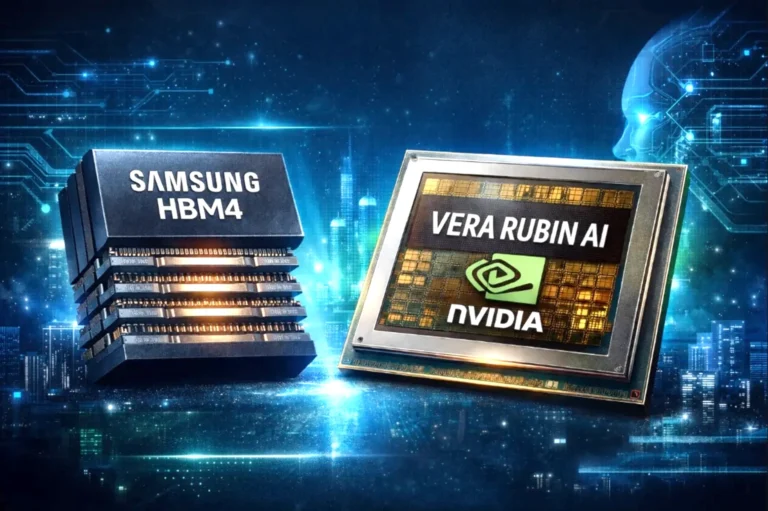
Suwon, South Korea – Sources in the technology sector announced that Samsung Electronics began mass production this month of the world’s first fourth-generation High-Bandwidth Memory (HBM4) chip. The company also plans to supply it to Nvidia next week for use in its advanced Vera Rubin AI processors.
Yonhap News Agency confirmed that Samsung successfully passed Nvidia’s quality tests, enabling the company to fulfill orders. This move reaffirms Samsung’s technological leadership in the high-performance chip market, particularly in advanced computing and artificial intelligence.
HBM4, the sixth generation of memory, is a key innovation that enhances the processor’s ability to handle data more efficiently. Furthermore, this memory supports complex applications in artificial intelligence, deep learning, and high-performance computing.
This move reflects Samsung’s significant investment in developing advanced chips to meet the growing global demand for artificial intelligence (AI) capabilities. It follows the company’s earlier announcement of a massive $310 billion investment plan over five years to expand its production in the chip and AI sectors.
Analysts indicate that supplying HBM4 to Nvidia strengthens the technological collaboration between the two companies. This collaboration also demonstrates Samsung’s global competitiveness in the high-performance chip industry.
It highlights a growing trend of supplying AI processor manufacturers with advanced components. As a result, the development of intelligent applications and innovative software is accelerating. This comes at a time when the global AI market is witnessing a fierce race to develop advanced memory solutions.
Leading companies aim to increase processing speed and improve power efficiency. Furthermore, these companies are striving to meet the needs of data centers and precision scientific applications. This further solidifies Samsung’s position as a key partner in this vital field.