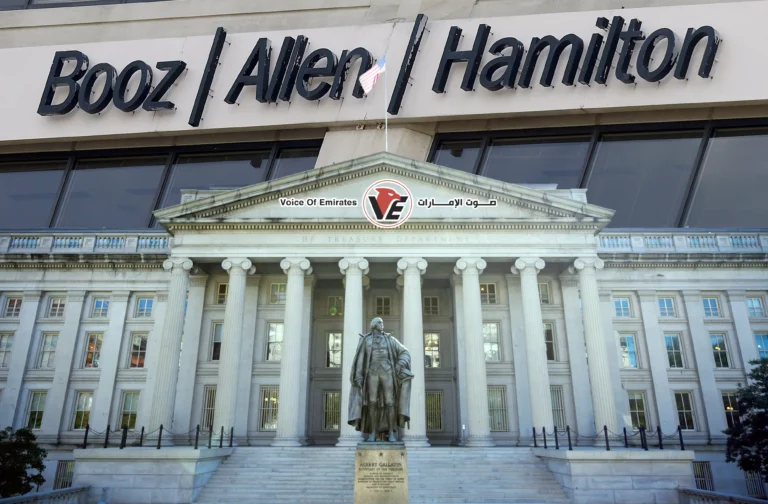
Washington, DC – The US Treasury Department announced the cancellation of all contracts with the government and military consulting firm Booz Allen Hamilton, citing its failure to protect sensitive taxpayer data.
The department explained that this decision stemmed from a massive leak of tax information by former employee Charles Edward Littlejohn,
who disclosed private information about prominent figures
such as Donald Trump, Elon Musk, Jeff Bezos, Warren Buffett, Michael Bloomberg, and others.
And the department indicated that it would cancel 31 contracts
with a total value of approximately $21 million, asserting
that “Booz Allen did not adequately protect the confidential tax information
it obtained through its work with the Internal Revenue Service.”
The biggest security breaches in US history
The leak, considered one of the largest security breaches in US history, included tax information dating back
more than 15 years, including details of investments, financial transactions, gambling profits,
and tax audit results. This data was used by Littlejohn in the leak, first to The New York Times and then to ProPublica.
Littlejohn pleaded guilty in October 2023 to unauthorized disclosure of tax data
and was sentenced to five years in prison, where he is currently serving his sentence in Florida.
Data leak affecting 406,000 taxpayers
Investigations revealed that the leak affected approximately 406,000 taxpayers, mostly businesses,
and that some non-billionaire individuals were also impacted because
their data was linked to the investment entities whose information was compromised.
In response to the ruling, Booz Allen asserted that it rejects any violations of the law
and that its former employee acted alone.
The firm added that it does not store taxpayer data on its systems and that
it fully cooperated with the government investigation, which led to Littlejohn’s prosecution.
This move comes on the first day of the 2026 tax filing season,
as part of the Department of Justice’s efforts to strengthen taxpayer data protection and restore public trust.