Cairo, Egypt – Since its discovery in commercial quantities at the beginning of the 20th century, oil has been more than just a source of energy or an engine of economic growth. It quickly became a major cause of international conflicts and a tool of political influence. For over a century, oil has been a decisive factor in igniting wars, redrawing alliances, and imposing sanctions. It has even been instrumental in pushing conflicting parties toward de-escalation or political settlements. Despite the absence of a formally declared “oil for peace” policy in the literature of international news agencies, historical and current realities confirm that oil has remained at the heart of the war-peace equation in the international system.
Historical overview: Oil as fuel for global conflicts
The direct link between oil and conflict began with World War I, when the major powers realized that control of oil resources meant military superiority. This link deepened during World War II, where oil became a decisive factor in the course of military operations. In the post-war period, oil became a focal point of geopolitical conflicts, particularly in the Middle East. The 1973 oil crisis marked a turning point, when Arab oil-producing states used an oil embargo as a tool for political pressure. This led to a global economic shock and solidified the concept of oil as an effective political instrument. This was followed by the 1979 crisis linked to the Iranian Revolution, then the 1990–1991 Gulf War, which was directly related to control of oil resources. Finally, the 2003 invasion of Iraq brought oil back to the forefront of discussions about the motivations behind modern warfare.
Oil… from a strategic commodity to a tool of political pressure
With the end of the Cold War, the nature of oil conflicts changed. Wars were no longer fought solely with armies. Instead, oil became a tool for economic sanctions, controlling exports and supplies, influencing global energy prices, and reshaping markets and alliances. This shift transformed oil into a soft power weapon in the hands of major powers. Its economic impact is thus used to achieve political objectives without resorting to direct military confrontation.
The US-Iran conflict: Oil at the heart of the confrontation
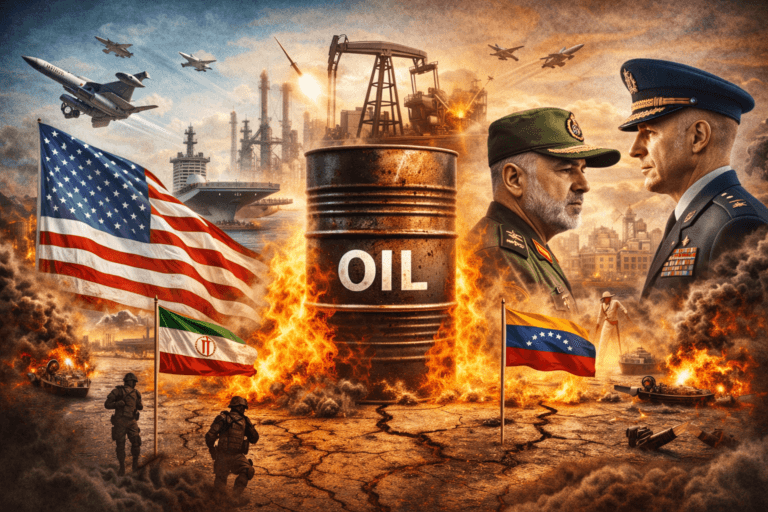
The conflict between the United States and Iran is a prime example of how oil can be used as a tool in international disputes. For decades, oil has been a central element of Washington’s policy toward Tehran, whether through sanctions or pressure on its oil exports. With the US withdrawal from the nuclear agreement in 2018, the policy of cutting off Iranian oil supplies intensified, aiming to reduce its economic revenues and limit its regional influence. In response, Iran has used its geographic location and its repeated threats to the Strait of Hormuz as strategic leverage. This has made global energy security hostage to political tensions in the region. This conflict clearly demonstrates how oil can be a driver of escalation or an unspoken bargaining chip in international relations.
Venezuela: Oil caught between sanctions and geopolitical conflict
In Latin America, Venezuela presents a different yet complex case within the context of the modern oil war. The country possesses the world’s largest proven oil reserves. However, in recent years, it has faced severe US sanctions directly targeting its oil sector. Washington seeks to exert political and economic pressure through these sanctions, while Caracas has attempted to circumvent them through partnerships with major powers such as China and Russia. This conflict has transformed Venezuelan oil into a bargaining chip in an international dispute that extends beyond Latin America and impacts global energy markets.
Can oil be a tool for peace?
Despite this long history of conflict, international studies and experiences indicate that oil can play a positive role if managed within a transparent and equitable institutional framework. In some instances, sharing oil revenues or cooperating on energy infrastructure has contributed to reducing tensions and promoting stability. This gives rise to an unspoken concept of what might be termed “oil for stability,” where oil is used as an incentive for economic cooperation rather than conflict, though this remains contingent on political will and good governance.