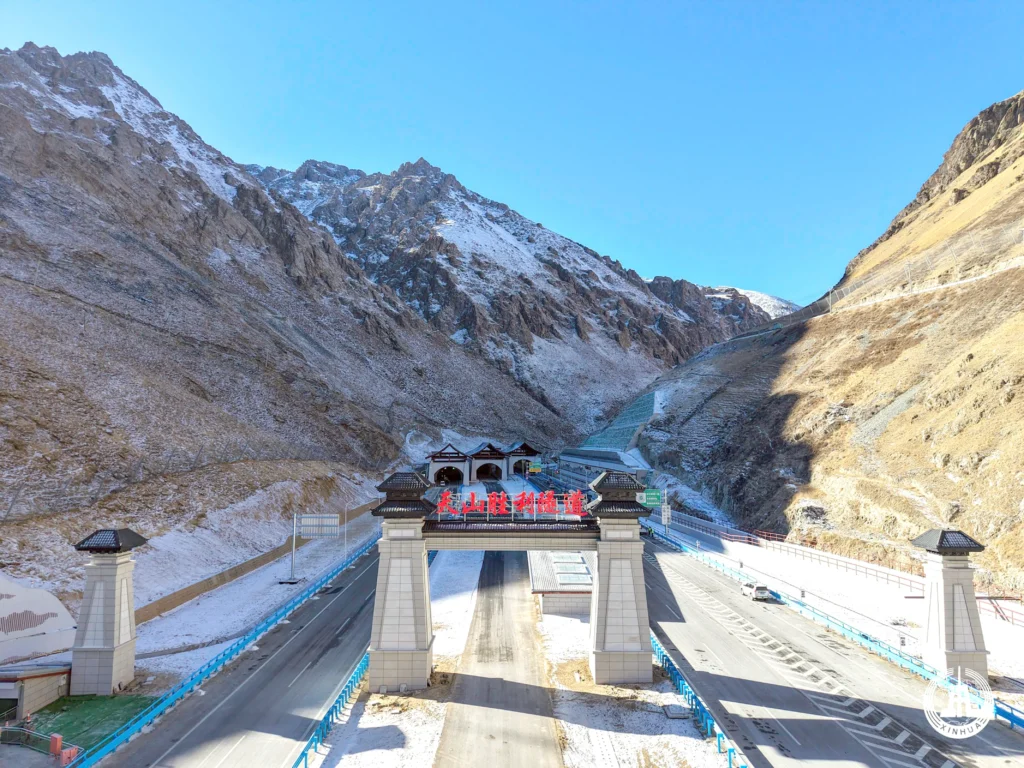
Beijing, China – China has officially opened the 22-kilometer-long Tianshan Shengli Tunnel in the Xinjiang Uyghur Autonomous Region, making it the world’s longest highway tunnel.
This giant project, which took five years to implement, has succeeded in reducing the travel time
between the capital “Urumqi” and the city of “Korla” from 7 hours to only 3.5 hours;
This represents a qualitative leap in the efficiency of transportation and logistics services within the region.
Environmental challenges above the clouds
In the same context, the tunnel acquires exceptional importance due to its strategic location
in the Tianshan Mountains at a high altitude of up to 3,000 meters above sea level.
The engineers faced harsh climatic conditions, with temperatures dropping to -42 degrees Celsius;
Accordingly, the tunnel was designed to withstand the harshest natural challenges.
Especially since the region forms a vital link with eight neighboring countries, including Kazakhstan and Pakistan.
Exceptional engineering and record-breaking numbers
Furthermore, since its launch in April 2020, the project has relied on a complex engineering strategy that included digging three parallel tunnels;
This is in order to facilitate geological studies and provide emergency exits and advanced ventilation systems.
Since the project included drilling vertical wells to a depth of approximately 700 meters,
China has set a new record for the deepest vertical shaft in the history of highway tunnels.
This reflects the superior capacity of Chinese engineering innovation.
An economic engine within the “dual trading” strategy
On the other hand, the tunnel’s role is not limited to facilitating traffic,
but it is a key pillar supporting trade and energy corridors between the north and the south.
Since China adopts a “dual trading” strategy to promote integration between domestic and foreign markets,
This tunnel will directly contribute to revitalizing economic ties with Central Asia;
This strengthens Xinjiang’s position as a global logistics hub on the modern Silk Road.

Project summary and future prospects
The Tianshan Shengli Tunnel is an inspiring example of how technology
can be adapted to serve development in the most challenging geographical environments.
Experts therefore expect this achievement to be reflected in the growth of regional trade.
This further proves China’s leadership in implementing cross-border infrastructure projects.
This ensures the sustainable flow of goods and energy in one of the world’s most rugged regions.