Sign In
Saturday, Apr 18, 2026
  • العربية
Top Header VOE Logo Header Dark Mode VOE Logo
  • Latest
  • Emirates
  • News
    • Gulf Countries
    • Arab Countries
    • World
  • Politics
    • Analysis
    • Interviews
    • Reports and investigations
  • Business
    • Companies
    • Real Estate
    • Stock Market
    • Green Energy
    • Oil And Gas
    • Bitcoin
    • Business Reports
  • Science and Tech
    • AI
    • Electric Vehicles
    • Space and Mars
  • Sport
    • World Cup 2026
  • Society
  • Health
  • Lifestyle
  • Travel and Hotels
Reading: Analysis: Mediation under pressure… Why are Pakistan, supported by Egypt and Turkey, leading the path to de-escalation between Washington and Tehran?
Share
Latest
Amid the Hormuz turmoil, Moscow reminds the world of issues that never fade away
Another loss in the south… Paris announces the death of a French soldier in Lebanon
Sundowns eliminate Esperance and qualify for the African Champions League final (video)
Europe is not facing new waves of migration; Berlin denies that the Iran war has affected immigration
From urban pressure to the power of opportunity: Egypt reshapes its urban development map
Font ResizerAa
Voice Of EmiratesVoice Of Emirates
  • العربية
  • Latest News
Search
  • News
    • Emirates
    • Gulf Countries
    • Arab Countries
    • World
  • Politics
    • Analysis
    • Interviews
    • Reports and investigations
  • Business
    • Companies
    • Real Estate
    • Stock Market
    • Green Energy
    • Oil And Gas
    • Bitcoin
    • Business Reports
  • Science and Tech
    • AI
    • Electric Vehicles
    • Space and Mars
  • Lifestyle
  • Society
  • Sport
    • World Cup 2026
  • Health
  • Travel and Hotels
Have an existing account? Sign In
Follow US
All rights reserved © Voice of Emirates - News service from Our Media Group
AnalysisPolitics

Analysis: Mediation under pressure… Why are Pakistan, supported by Egypt and Turkey, leading the path to de-escalation between Washington and Tehran?

Diplomatic moves led by Islamabad, with support from Cairo and Ankara, to prevent the war from spreading to the Gulf and the region.

Mobile Logo
Last updated: 29/03/2026 4:56 pm
Editorial Team
3 weeks ago
Share
6 Min Read
Analysis: Mediation under pressure... Why are Pakistan, supported by Egypt and Turkey, leading the path to de-escalation between Washington and Tehran?
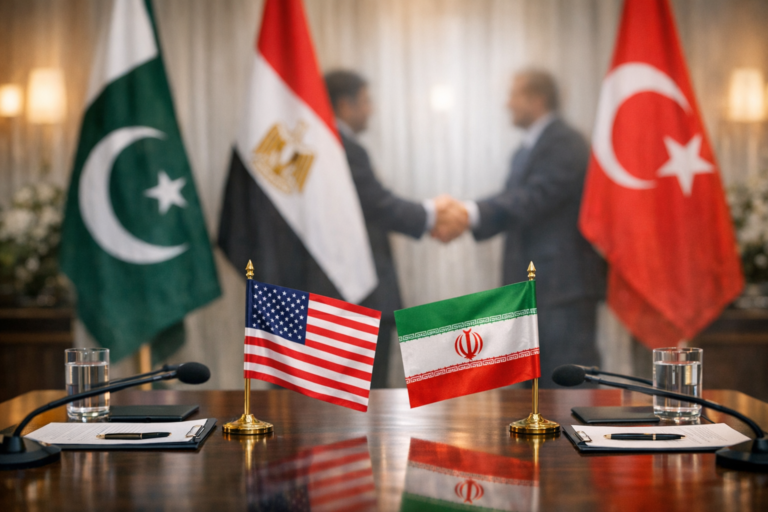
A symbolic image of a diplomatic meeting reflecting regional mediation between Washington and Tehran, supported by Pakistan, Egypt, and Turkey. (Image/Voice of Emirates)
SHARE
Highlights
  • Islamabad is making progress towards de-escalation
  • Pakistan: A mediation shaped by geography and alliances
  • Egypt: Containing the escalation to protect security and the economy
  • Turkey: Political support to prevent the escalation of the confrontation
  • Mediation of interests, not mediation of neutrality
  • Will regional channels succeed in stopping the war?

Dubai, UAE – As regional efforts intensify to contain the conflict between the United States and Iran, Islamabad has emerged as a hub for attempts to open an indirect negotiating channel. This follows a ministerial meeting that included Pakistan, Egypt, Turkey, and Saudi Arabia to discuss de-escalation. Political analysts suggest this move reflects not only a desire to mediate but also a genuine concern among these countries that the conflict could escalate further. Such an escalation would threaten the security of the Gulf, maritime navigation, energy supplies, and the global economy.

Islamabad is making progress towards de-escalation

Pakistan appears to be the most proactive party in this process, not only because it maintains channels of communication with both Washington and Tehran, but also because it has positioned itself as a suitable conduit for indirect messages between the two sides. This stance grants Islamabad a prominent political role. However, it simultaneously reveals the extent of the predicament it seeks to avoid should the war escalate.

Pakistan: A mediation shaped by geography and alliances

Pakistan shares a direct border with Iran and is heavily dependent on the stability of the Gulf and its maritime routes. Its defense relationship with Saudi Arabia makes any escalation of the conflict in the Gulf a highly sensitive development for it. Therefore, Pakistani mediation appears to be an attempt to avoid a slide that could place it under strategic pressure. It finds itself caught between its Gulf commitments and its complex relationship with Iran.

This equation makes Islamabad’s move more than just a traditional diplomatic effort; it is essentially a preemptive attempt to protect its security and political interests. It is also an attempt to prevent reaching a point where it is forced to choose between two important partners in a highly complex regional equation.

Egypt: Containing the escalation to protect security and the economy

Egypt, however, is operating from a different but no less urgent perspective. Cairo views any escalation of the war in the Gulf as a direct threat to regional stability. It also sees potential repercussions for maritime security, trade, and energy supplies, as well as broader economic consequences for the entire region.

From this perspective, Egypt appears eager to mediate not only as a diplomatic role, but also as a preventative necessity. The closer war gets to the Gulf, the higher the cost of tension will be for Arab economies and for trade and energy flows. Furthermore, the cost to regional security balances will increase. Therefore, Egypt’s move can be interpreted as an attempt to prevent a moment when Arab capitals are forced to make more difficult and costly choices—politically, economically, and in terms of security.

Turkey: Political support to prevent the escalation of the confrontation

For Turkey, its support for the Pakistani approach is based on calculations of both influence and strategic location. Ankara understands that the continuation or expansion of the war threatens the stability of its regional neighborhood. It also increases the likelihood of security and economic chaos in a region where its direct interests intersect with energy, trade, and security issues.

Turkey also possesses diplomatic leeway with multiple parties, enabling it to play a supportive role in keeping lines of dialogue open. It is also capable of preventing the conflict from spreading to additional arenas. Therefore, its involvement in this process appears to be part of a broader policy aimed at preventing a complete regional collapse.

Mediation of interests, not mediation of neutrality

Ultimately, Pakistan, Egypt, and Turkey are not acting simply because they are neutral in the traditional sense, but because they stand to lose the most from the consequences of failure. Pakistan fears that the war will become a direct test of its balance between Saudi Arabia and Iran. Egypt sees the security of the Gulf and the stability of energy markets as integral to its strategic and economic security. And Turkey views the war as a direct threat to the stability of its regional neighborhood.

Therefore, mediation here appears to be more of an expression of converging interests and a need for de-escalation than a mere protocolary initiative. These countries are not acting from the position of mere spectators, but rather from a position of understanding that the expansion of the war will impose upon everyone a price that will be difficult to bear later.

Will regional channels succeed in stopping the war?

However, the success of this approach hinges on shifting efforts from crisis management to initiating direct or indirect negotiations between Washington and Tehran. So far, indications suggest that regional meetings have succeeded in establishing communication channels and exchanging messages. But they have yet to produce a decisive political breakthrough. As the situation on the ground continues to escalate, the mediators’ ability to prevent further deterioration will depend on the willingness of both sides to give diplomacy a chance beyond simply buying time. Until that happens, regional mediation will remain a necessary attempt to contain the conflict, but it is not sufficient on its own to extinguish it.


TAGGED:Arabian GulfEgyptIranIsraelmediationpeaceTurkeyUSVoice Of Emiratesباكستان
SOURCES:Voice Of Emirates
Share This Article
Facebook Whatsapp Whatsapp LinkedIn Telegram Threads Email Copy Link Print
Previous Article Breaking | Nabil Fahmy appointed Secretary-General of the Arab League Breaking | Nabil Fahmy appointed Secretary-General of the Arab League
Next Article Where are things headed in Aden? A "fiery" statement from the Southern Transitional Council sets a date for the march on Tawahi Where are things headed in Aden? A “fiery” statement from the Southern Transitional Council sets a date for the march on Tawahi
25°C
Dubai
clear sky
25° _ 25°
67%
5 km/h
Sat
25 °C
Sun
27 °C
Mon
28 °C
Tue
30 °C
Wed
32 °C

Editor's Pick

Amid the Hormuz turmoil, Moscow reminds the world of issues that never fade away

Amid the Hormuz turmoil, Moscow reminds the world of issues that never fade away

Russia highlights its role in Middle East crises

By
Medhat Elsheikh
2 Min Read
Another loss in the south... Paris announces the death of a French soldier in Lebanon
Another loss in the south… Paris announces the death of a French soldier in Lebanon

France is investigating the circumstances surrounding the soldier's death in Lebanon.

2 Min Read
Sundowns vs Esperance Tunis match
Sundowns eliminate Esperance and qualify for the African Champions League final (video)

Pretoria, South Africa – Mamelodi Sundowns of South Africa qualified for the…

1 Min Read

Trending

Europe is not facing new waves of migration; Berlin denies that the Iran war has affected immigration

Europe is not facing new waves of migration; Berlin denies that the Iran war has affected immigration

Europe: Details on border management and control

35 minutes ago

From urban pressure to the power of opportunity: Egypt reshapes its urban development map

Egypt: Challenges and Opportunities in Urban…

1 hour ago

A prayer turns controversial: Irish priest sparks laughter and criticism with a remark about Trump

Ireland and testimonies regarding the priest's…

1 hour ago

Rumors precede the truth… What happened to the story of Khamenei’s burial after the allegations of his assassination?

Iran: How rumors are causing unrest…

1 hour ago

The elegance of power or the protocol of influence? How did Trump impose the suit of politics on his men?

Trump and the classic style of…

2 hours ago

You may also be interested in

Apache helicopters over Hormuz... Washington secures the world's most dangerous waterway
Reports and investigations

Apache helicopters over Hormuz… Washington secures the world’s most dangerous waterway

Washington, DC – US Central Command announced that its Apache helicopters conducted flights over the Strait of Hormuz. This comes…

2 Min Read
Trump: Information expected regarding developments in the Strait of Hormuz by the end of the day
NewsWorld

Trump: Information expected regarding developments in the Strait of Hormuz by the end of the day

Washington, DC – US President Donald Trump announced that his country would receive new information on the situation in the…

1 Min Read
The President and his two deputies congratulate the President of Zimbabwe on Independence Day
Emirates

The President and his two deputies congratulate the President of Zimbabwe on Independence Day

Abu Dhabi, UAE – His Highness Sheikh Mohamed bin Zayed Al Nahyan, President of the UAE, sent a congratulatory cable…

1 Min Read
Saqr Ghobash: The problem with Iran begins with its constitution and contradicts the sovereignty of states
AnalysisPolitics

Saqr Ghobash: The problem with Iran begins with its constitution and contradicts the sovereignty of states

Istanbul, Turkey – Saqr Ghobash, Speaker of the Federal National Council, affirmed that the core of the problem with Iran…

3 Min Read
Top Header VOE Logo Header Dark Mode VOE Logo
  • About Us
  • Contact us
  • Advertise with us
  • Privacy Policy
Reading: Analysis: Mediation under pressure… Why are Pakistan, supported by Egypt and Turkey, leading the path to de-escalation between Washington and Tehran?
Share
  • Publishing Principles
  • Ethics Policy
  • Corrections Policy
  • Diversity Policy
  • Actionable Feedback Policy
  • Ownership & Funding
  • Privacy Policy
Reading: Analysis: Mediation under pressure… Why are Pakistan, supported by Egypt and Turkey, leading the path to de-escalation between Washington and Tehran?
Share

All rights reserved © Voice Of Emirates – a news service from Our Media Group

Welcome Back!

Sign in to your account

Username or Email Address
Password

Lost your password?