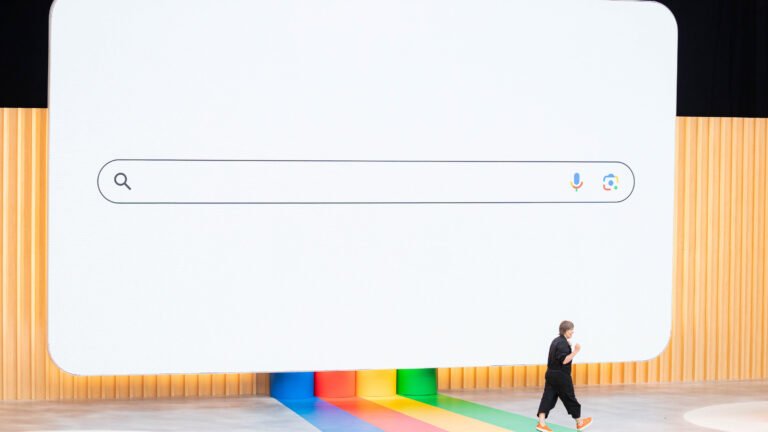
Washington, USA – In perhaps its most significant move since inception, Google is spearheading a technological revolution. The company is transforming its Google search engine from a tool that retrieves links into a comprehensive “digital advisor” system. This shift isn’t just a technical update; it’s a fundamental change in the philosophy of accessing information. Now, “Generative AI” replaces the traditional methods we have relied on for over two decades.
Users are no longer restricted to crafting precise keywords to get a result. Instead, you can now ask a complex question, request a comparison, or even describe a scenario. The engine will analyze the context to provide an immediate, accurate, and comprehensive answer.
“Conversation with Knowledge” Instead of Searching
In a related context, tech experts believe we are moving from the era of “searching” to the era of “conversing with knowledge.” The new Google search engine doesn’t just offer a list of sites that might contain an answer. Rather, it provides the answer itself after processing and summarizing billions of pages in milliseconds. This significantly reduces the user’s “cognitive load.” As a result, information retrieval becomes an interactive process.
Challenges and Opportunities in the AI Era
Furthermore, this evolution raises critical questions for content creators and website owners:
Traffic Future: If the answer appears directly in the search interface, will users still visit the source websites?
Accuracy and Neutrality: How does Google ensure that AI-generated answers are perfectly accurate and unbiased?
Content Rights: How will Google balance providing direct answers while protecting the rights of the sites that provide the raw information?
Toward a Personalized Digital Future
On another note, this transformation aims to make the Google search engine more “personalized.” By understanding user behavior and the context of previous queries, the engine can anticipate your needs and offer customized insights. We are entering an era where searching the internet transforms into an experience similar to consulting with a tech-savvy expert. This expert will possess the sum of human knowledge.
In conclusion, Google’s redefinition of search is the harbinger of a new era. While technical and ethical challenges remain, the future seems to be heading toward machines that understand us and anticipate our needs before we even type them. The search engine we knew in 2000 will not be the same by 2030. Clearly, we are currently in the midst of the greatest “digital evolution.”