
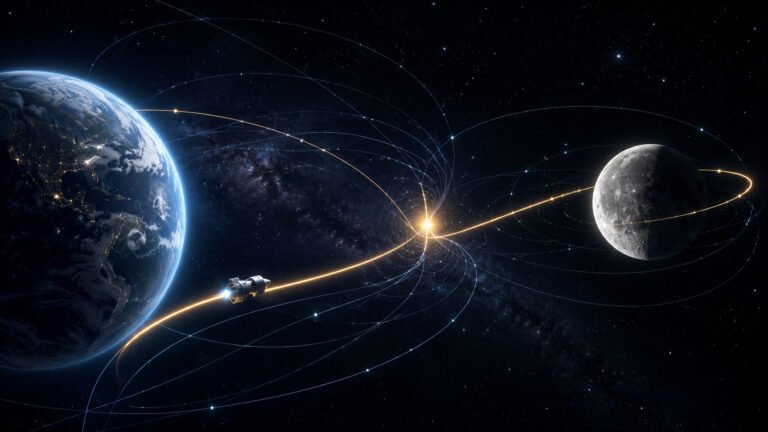
Washington, USA – Amid the intense race to explore deep space, the concept of “Gravity Highways” (or low-energy orbital paths) is emerging as a promising scientific solution that is redefining the economics of space travel. Consequently, global interest is shifting toward utilizing these low-energy trajectories as a brilliant alternative to expensive traditional rocket fuel. This technique relies on exploiting the complex gravitational balances between the Earth, the Moon, and the Sun to guide spacecraft. From this perspective, vehicles travel via natural paths that do not require constant rocket propulsion, much like utilizing ocean currents in maritime navigation.
A Navigation Revolution: Cosmic Balances as High-Speed Routes
On the other hand, the importance of these pathways is not limited to saving fuel; it extends to enhancing the efficiency of long-term missions. Space experts are currently developing precise simulation models to map these “hidden space roads.” Furthermore, these routes allow vehicles to travel between Earth and the Moon with high flexibility, significantly reducing the required launch weight of the spacecraft. Consequently, these weight and fuel savings translate directly into lower total mission costs, opening the door for an increased frequency of scientific and commercial missions to the lunar surface and beyond.
Complex Calculation Challenges in Deep Space
In the same context, despite this incredible potential, specialists acknowledge significant technical challenges. Navigation via gravity highways requires extremely complex mathematical calculations and is sensitive to the slightest fluctuations in orbital balances. Therefore, even a minor deviation could lead a vehicle off course, making the practical application of this technology a task that demands advanced navigation systems and AI capable of making real-time corrective decisions. As a result, the use of these paths remains limited to precise experimental missions until we can refine them for wide-scale use in the near future.
Toward a Sustainable Future for Mars and Moon Exploration
Ultimately, experts agree that gravity highway technologies will play a pivotal role in the sustainability of Moon and Mars exploration programs. Based on this, seeking more sustainable ways to reduce the cost of reaching space is not just a scientific luxury; it is an economic necessity for both government institutions and private companies. As global interest in establishing permanent lunar bases grows, gravity highways will become the “economic artery” connecting Earth to celestial bodies, transforming space missions from prohibitively expensive adventures into routine and sustainable operations.