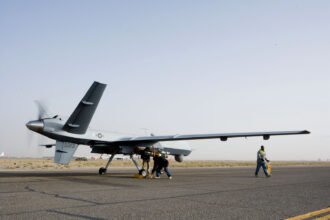

Washington, DC – Developments in the ongoing conflict with Iran have revealed profound shifts in the nature of modern warfare. These developments have prompted the United States to reassess its military strategies, particularly in light of the increasing reliance on low-cost drones.
Field experience has shown that wars are no longer solely dependent on expensive conventional weapons. Instead, they are increasingly employing less costly and more widespread weapons. This has imposed a new reality on policymakers in Washington.
In this context, US officials have acknowledged a gap in the economic efficiency of military operations. According to the Department of Defense, it is no longer feasible to continue using expensive missiles to intercept inexpensive drones. Therefore, the development of more flexible and cost-effective alternatives is necessary.
These developments have prompted the Pentagon to intensify its research into new technologies, including expanding the production of attack drones. It is also working to enhance its electronic warfare capabilities, aiming to achieve a balance between cost and effectiveness on the battlefield.
These shifts reflect a growing awareness that the nature of future warfare will depend on numerical superiority and advanced technology, rather than traditional superiority based solely on heavy weaponry. Consequently, this could reshape the global landscape of military power in the coming years.
These developments are occurring amidst a rapidly escalating military buildup. This necessitates that major powers reformulate their combat doctrines to align with the nature of new threats that are no longer conventional or predictable.