Cairo, Egypt – In an exclusive interview with “Sawt Al Emarat”, the Syrian Kurdish poet Hevi Qajo revealed the features of her unique poetic experience, and about her upbringing between two cultures that formed the basis of her literary identity:
Kurdish, which she was born into and absorbed since childhood, and Arabic, which she says she learned by force, but which over time became another bridge to creativity.
A dual poetic identity: Kurdish is the source of inspiration, and Arabic is the space of expression.
Qajo says that when poetic inspiration visits her imagination, “it comes of Kurdish origin.”
But in her writing, she seeks to formulate it in a style that does not negate its Kurdishness.
Rather, it gives it an Arab dimension at the same time, so that the text becomes a true blend of two cultures.
She explains that this blending is not just an aesthetic choice, but a necessity imposed by living between two languages and two memories.
Qajo believes that place plays a profound role in shaping a writer’s identity: “The feeling of belonging to a place makes it part of the creative process,
A person’s memories are the fuel that stimulates their imagination and influences their style, whether they like it or not.
The Pain of Memory and the Transformations of the Self: Her First Collection of Poems is a Testimony to Sorrow
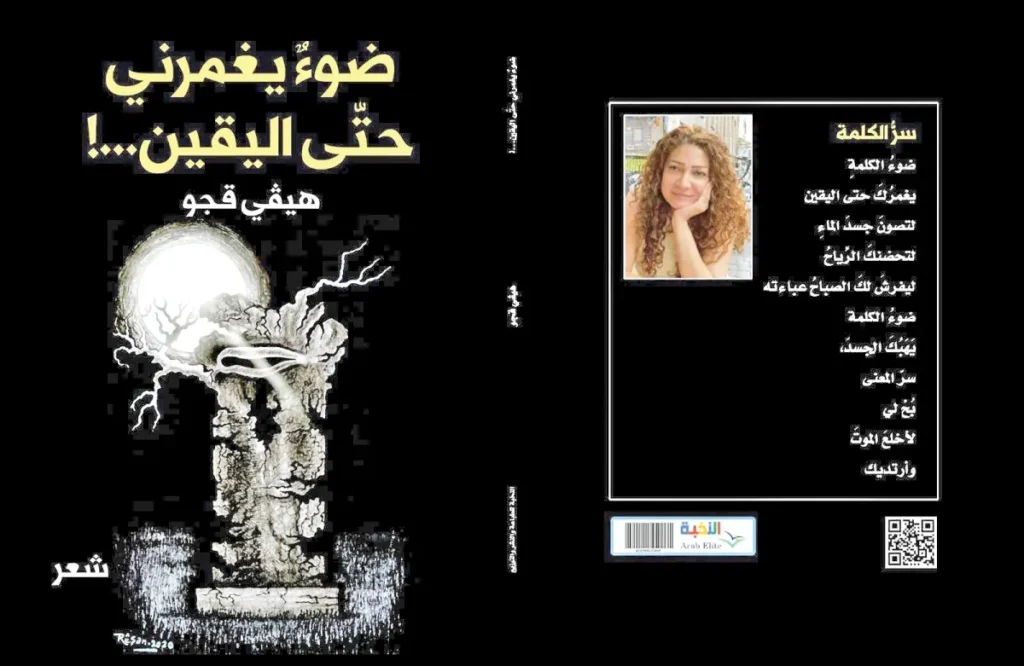
Qajo pauses at her first collection of poems, “A Light That Overwhelms Me to the Point of Certainty,” and describes it as a collection of painful memories that she carried for a long time.
So I wrote it, hoping that writing would take her out of the circle of sadness that contributed to shaping her identity.
She adds: “Sometimes I immerse myself in that sadness to the point of identification, and sometimes I soar above it, rebellious, reshaping this existence.”
Woman… the voice of truth
The poet affirms that women are the focus of her narrative and poetic texts.
When a woman writes her history and feelings with boldness and transparency,
She says, “does not need the pen of the man who wrote a distorted history about her over time.”
She adds that the voice of the free woman is the essence of her literary experience, and it is the hero that appears in most of her texts.
The Kurdish issue… a cause that will not be extinguished
Qajo believes that the Kurdish issue was and will remain the “greatest concern” of the Kurdish people.
Which made enormous sacrifices for the right to self-determination, despite being torn apart by four regional states.
She emphasizes that the Kurdish writer cannot be immune to this conflict:
“Politics overshadows everything for us, and the writer is a product of his environment; it is his responsibility to be a guiding light for those around him.”
It is worth remembering that the Qamishli uprising of 2004 was a stark example of the marginalization and oppression suffered by the Kurds.
These events shaped the collective consciousness of the Kurds and were strongly reflected in the literary experience.
المنفى: ملاذ يمنح السكينة.. وينتزع الأشياء الغالية
Qajo speaks honestly about her immigration experience, which gave her security but took a lot from her.
She says: “I miss my family, friends, and the streets of my city, and I long for the warmth of that city, which is crazy about its lovers.”
Exile is cold by nature, and its routine haunts one in its details.
However, she believes that this isolation led her to reflect, and contributed to the development of her creative experience.
The Kurdish cultural scene: rich in creativity… but poor in support
Qajo asserts that Kurdish literature is rich with powerful experiences in poetry, novels, and short stories, but the problem lies in the weakness of translation and the lack of institutional support:
“Many writers, both men and women, did not get their chance, not because of weak texts,
Rather, it is due to the absence of institutions that would protect them from marginalization.”
She believes that the emergence of translated Kurdish names is mostly due to relationships
And coincidence is more than just a genuine recognition of the value of the Kurdish literary experience.
Texts written from the heart… to whoever reads them
Qajo says that any text she finishes writing represents a “qualitative leap” in her experience.
Rather, it is a “lifeline” that propels her to a deeper level of writing.
She adds that she always strives to write something unusual that gives the reader surprise and enjoyment.
It concludes with a message to the reader who is reading it for the first time:
“Read me carefully, and let your soul soar with the words. If your soul merges with the text, know that it was written by you, and no one else.”
Upcoming releases
Hevi Qajo reveals that she is preparing to release a new poetry collection and a collection of short stories that is currently being printed.
This is to add them to her literary career, which is shaped between pain, memory, and exile, and between the language of the heart and the language of life.
Who is Hevi Qajju? (Biography)
Hevi Qajo is from the city of Amuda, Rojava, Kurdistan, Syria. She studied kindergarten in Berlin, Germany.
She worked as a broadcaster, program and report producer at ARTA FM radio in Amuda, and as a trainer at the Alternatives for Peace Foundation in Rojava.
Literary works
Another After: (Narrative Margins, Short Stories) A collection of short stories published by Dar Al-Fada’at/Jordan 2020.
The Musician’s Fingers or the Sound of a Distant Flute: (Narrative Notes) Published by Dar Al-Nabigha / Egypt 2020.
High Stairs… Blind Spots: Narratives, published by Dar Al-Nabigha / Egypt 2021.
A light that floods me until certainty: A collection of poems published by Dar Al-Nukhba / Egypt 2023.
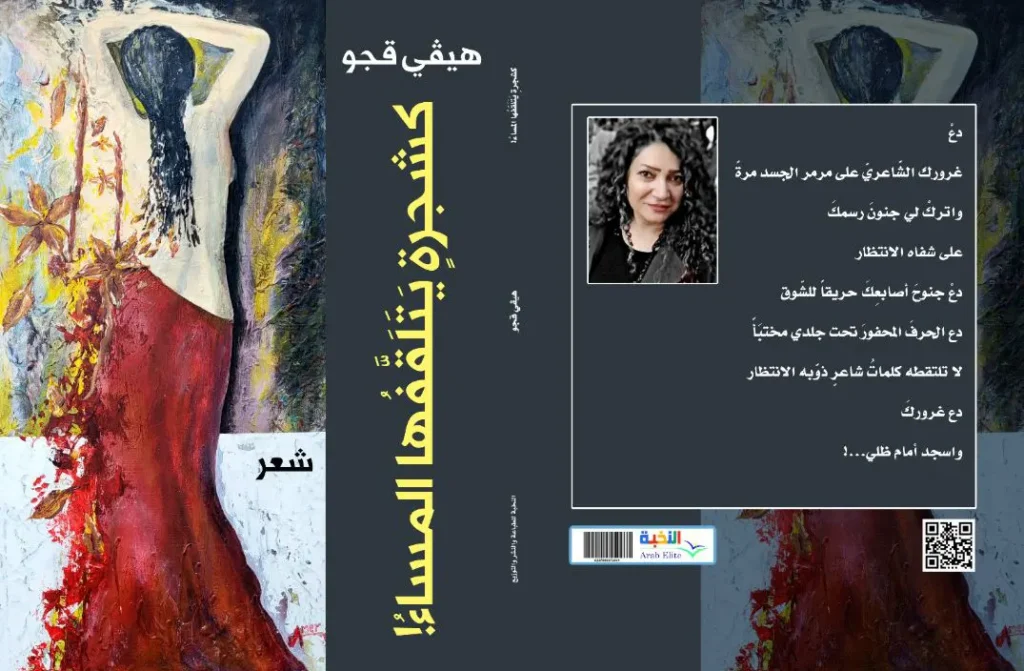
Like a tree snatched by the evening: A collection of poems published by Dar Al-Nukhba/Egypt 2023.
A collection of poems and a collection of short stories are currently being printed.