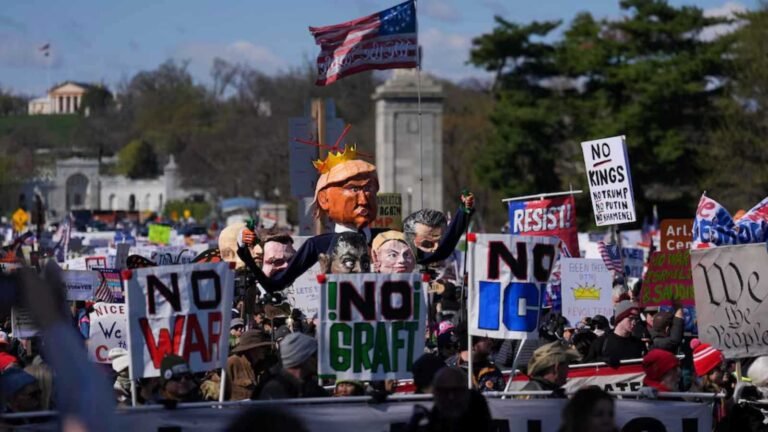
Washington, DC – In a scene reflecting the deep polarization of the United States, the country witnessed its third round of “No Kings” marches on Saturday. Millions took to the streets in more than 3,200 events across all 50 states.
Protesters denounced what they called President Donald Trump’s “authoritarian approach.” They also criticized his forced deportation policies, military involvement in the conflict with Iran, and what they perceived as a threat to the foundations of American democracy.
The protests are spreading
Organizers emphasized that this year’s demonstrations saw a significant surge in activity in small communities and rural areas, with a 40% increase in turnout compared to previous rallies. This indicates a broadening of the opposition beyond major liberal strongholds.
In St. Paul, Minnesota, the state capitol became a focal point for protests against immigration practices, particularly following the federal shooting deaths of Renee Goode and Alex Peretti.
sharp political messages
The marches drew prominent figures, with Minnesota Governor Tim Walz addressing the crowds, saying their resistance was the “heart and soul” of America. He also described them as “extreme in democracy and compassion.”
Senator Bernie Sanders joined the event, declaring, “We will not allow this country to slide into tyranny.” Musician Bruce Springsteen added a touch of melancholy with his song “Streets of Minneapolis.” In contrast, the Republican National Committee attacked the gatherings, labeling them “anti-American rallies” and claiming they embodied the violent fantasies of the radical left.
Clashes and arrests
The marches were not without tension. In New York, crowds sprawled across dozens of blocks, led by actor Robert De Niro. In Dallas, clashes broke out between protesters and far-right groups led by Enrique Tarrio.
In Los Angeles, federal authorities used tear gas to disperse gatherings near a federal prison, resulting in several arrests.
electoral implications
These protests come at a sensitive time, with the midterm elections approaching and Trump’s approval rating having fallen to 36% according to Reuters/Ipsos polls. Leah Greenberg, co-founder of the Indivisible movement, believes the surge in protest activity in traditionally Republican states and swing districts could be the deciding factor in shaping the next Congress.