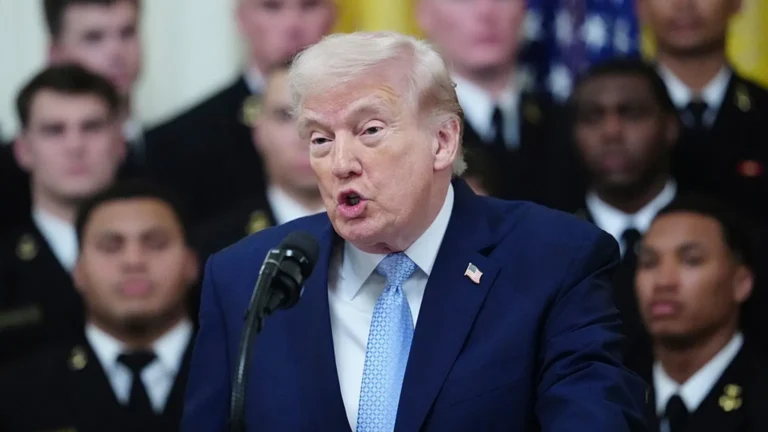
Washington, DC – US President Donald Trump has placed the Middle East and the entire world on the brink of a full-blown military confrontation. He reiterated his unwavering commitment to the principle of “peace through strength.” On his Truth Social platform, Trump issued a stark ultimatum to the Iranian leadership, writing in bold capitals: “Peace is achieved through strength.” This was a clear indication of the readiness of the US military to impose a new reality in the region by force. Trump also set a 48-hour deadline for the full reopening of the Strait of Hormuz to international shipping. He threatened to target Iranian power plants, starting with the country’s largest facility, if the deadline passed without a response. In a brief but firm reply to a question about the potential consequences, Trump said: “You’ll see what happens.”
In an exclusive interview with Israel’s Channel 13 on Sunday evening, March 22, 2026, Trump asserted that military pressure would yield “very positive” results. However, he warned that Tehran could face “total destruction,” stating that this would be effective in achieving Washington’s strategic objectives. Trump also unleashed his anger on NATO allies, describing their inaction regarding Iran’s policies over the past 47 years as a “great disgrace.” He emphasized that Tehran was now beginning to receive its “just punishment.”
On the other hand, the Iranian response was swift and defiant; the Revolutionary Guard and the Khatam al-Anbiya Headquarters declared a state of maximum alert. Iran threatened to target all of Israel’s power plants if tensions escalated. Furthermore, it threatened to target the facilities of regional countries that supply electricity to US bases should their infrastructure be attacked. Tehran also asserted that the option of a complete closure of the Strait of Hormuz was now firmly on the table as a strategic deterrent.
Observers believe this direct confrontation jeopardizes global energy security, as approximately 20% of the world’s oil supply passes through the Strait of Hormuz. With the escalating exchange of attacks, analysts warn of the region sliding into an unprecedented economic and security crisis. This comes amidst Washington’s insistence on “breaking Tehran’s will” and the latter’s response of threatening the “vital interests” of the United States and its allies. Therefore, the coming hours are shaping up to be the most critical in the region’s modern history.