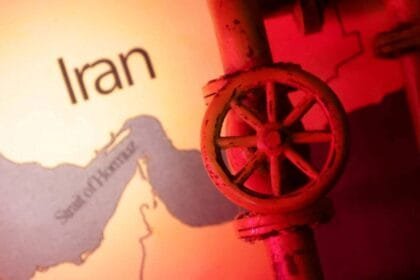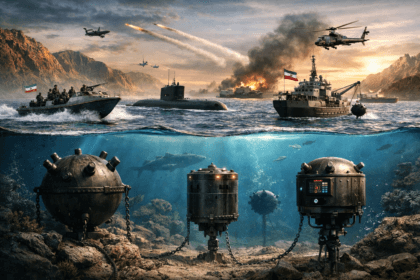
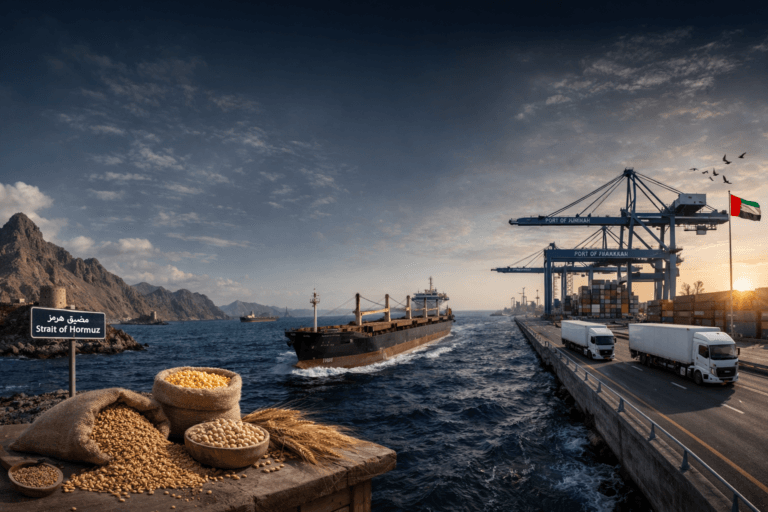
Dubai, UAE — The security risks in the Strait of Hormuz are no longer viewed solely as a shipping crisis, but as a direct test of the Gulf states’ ability to safeguard food supply chains. The Joint Maritime Information Centre (JMIC) has maintained a critical risk level in the Arabian Gulf, the Strait of Hormuz, and the Gulf of Oman. Warnings for commercial shipping in and around the strait remain in place. This places increasing pressure on imports of grains, vegetable oils, oilseeds, and other essential commodities. And the longer the disruption persists, the greater the pressure will be.
These developments are of particular importance to the Gulf region because a significant portion of its food security depends on the regular maritime flow of essential commodities, especially grains, food raw materials, and animal feed. With any prolonged disruption, the challenge lies not only in maintaining stockpiles but also in the speed of replenishing them. Furthermore, the efficiency of cargo diversion poses a significant challenge. In addition, the capacity of alternative ports to handle a sudden surge in traffic becomes a critical concern.
Ports and cities most connected to the food supply line
On the food supply route that crosses the Strait of Hormuz into the Gulf, the UAE is at the forefront through its Jebel Ali Port in Dubai and Khalifa Port in Abu Dhabi. At Jebel Ali, specialized projects are underway for the storage and processing of agricultural products, including grains, corn, soybeans, and pulses. At Khalifa Port, the development of a state-of-the-art grain storage and processing facility with a capacity of approximately 300,000 metric tons has been announced. This further strengthens the UAE’s role in receiving and redistributing food.
In Saudi Arabia, King Abdulaziz Port in Dammam stands out as one of the most important ports in the Gulf, with ships passing through the Strait of Hormuz. In Qatar, Hamad Port serves as a major hub for food imports, and officials confirm that the port includes a grain terminal with a capacity of up to one million tons annually. In Kuwait, Shuwaikh Port near Kuwait City is one of the most important commercial ports for receiving and distributing goods. Similarly, Khalifa Bin Salman Port in Bahrain is a major trade gateway and is linked to redistribution operations within the Gulf.
On the geographical edge closest to the shipping lane, Khasab in Oman’s Musandam Governorate stands out as a city adjacent to the Strait of Hormuz. Meanwhile, Fujairah and Khor Fakkan lie on the UAE’s east coast, just outside the strait. This location gives these cities and ports significant logistical value in any plan to divert food supply routes away from congested areas.
Fujairah and Khor Fakkan are among the leading alternatives
If the disruption persists or the risks escalate, the most obvious alternative begins in the UAE, specifically through the ports of Fujairah and Khor Fakkan. Fujairah describes itself as the only multi-purpose port on the UAE’s east coast and is located approximately 70 nautical miles from the Strait of Hormuz. Khor Fakkan, according to its operator, is the only fully-fledged UAE commercial terminal located outside the Strait of Hormuz. This makes it a natural receiving point for shipments that need to be diverted away from the immediate path of the tension.
This alternative then extends to the Sultanate of Oman via the port of Sohar on the Gulf of Oman, outside the strait. From there, it continues to the ports of Duqm and Salalah on the open coast leading to the Arabian Sea. Sohar’s significance lies in its dedicated terminal for handling bulk agricultural commodities, including grains, which supports the strategic food reserve. This makes it a direct component of any alternative route for Gulf food security.
Starting the transformation and implementation plan
In a development revealing the UAE’s shift from preparation to implementation, sources told “Voice Of Emirates” that the UAE has already begun a plan to divert some of the shipping traffic carrying food and essential goods to the ports of Fujairah and Khor Fakkan. This is part of proactive measures aimed at ensuring the smooth flow of imports and mitigating the impact of any potential disruption to navigation through the Strait of Hormuz.
According to sources, relevant authorities in the UAE have begun contacting their counterparts in the Sultanate of Oman to facilitate the passage of ships and coordinate the reception of shipments at ports located on the open coast and outside the maritime congestion zone. This is a prelude to redirecting these shipments to Gulf markets and the most affected countries. These moves reflect a clear Emirati inclination to play a pivotal role in regional food security by securing alternative routes for grains and essential commodities, which are then redistributed to other countries as needed.
What measures were taken to protect the markets?
On an official level, the UAE has confirmed that it possesses a strategic reserve of essential goods sufficient for up to six months. Stockpiles, markets, and prices are being monitored daily to ensure continued availability and prevent bottlenecks or shortages of essential commodities. In this sense, this message implies that the current challenge is not only about the availability of goods, but also about the speed with which supplies can be replenished should the maritime disruption persist.
In Saudi Arabia, the Ports Authority announced the addition of MSC’s Gulf Shuttle shipping service to King Abdulaziz Port in Dammam, a move that supports the smooth flow of trade and enhances operational efficiency. In Qatar, Hamad Port and its associated grain terminal provide a crucial logistical buffer for securing essential supplies. In Kuwait and Bahrain, maintaining smooth transit or activating regional support routes remains critical. This is essential in mitigating any market pressures.
Possible scenarios for food security in the Gulf
The first scenario is rapid containment, where the repercussions remain limited to shipment delays and increased transportation and insurance costs, with the UAE, Saudi Arabia, Qatar, Kuwait, Bahrain, and Oman able to absorb the impact through existing stockpiles and alternative routes. The second scenario is a disruption lasting for weeks, at which point real pressure begins on faster-moving commodities such as grains, oils, animal feed, and other essential goods linked to a regular supply cycle. The third scenario, the most dangerous, involves a prolonged disruption or an expansion of the risk to include the alternative ports themselves. The central question then becomes: can these countries replenish their stockpiles quickly enough?
What needs to be done now?
What is needed now is to establish a clear alternative route for food shipments starting from Fujairah and Khor Fakkan, then expanding to Sohar, Duqm, and Salalah as needed, linked to land transport plans, rapid storage, and redistribution across the region. There is also an urgent need for a daily Gulf operations room for food security and logistics to monitor ship movements, unloading capacities, stock levels, prices, and the prioritization of grains and essential commodities at alternative ports. Therefore, expediting clearance and transport procedures between ports open to the Arabian Sea and Gulf markets is crucial. This will also prevent logistical delays from directly impacting food security.
Summary
The real danger to the Gulf lies not in a temporary disruption lasting a few days, but in any prolonged disruption that prevents grain and essential commodities from reaching ports within the Gulf or delays the replenishment of stockpiles. So far, the UAE appears well-positioned to lead the response, thanks to its declared reserves, its alternative location on the east coast, its diversionary port infrastructure, and its early move toward regional coordination. Should the crisis persist, the measure of success will not be solely the availability of reserves, but rather the speed of rerouting and the efficiency of redistribution. This places the UAE at the heart of the Gulf’s food security equation during this current phase.