Washington, DC – In a major legal blow to the Trump administration’s economic agenda, the White House announced Saturday the termination of a series of tariff imposed by President Donald Trump.
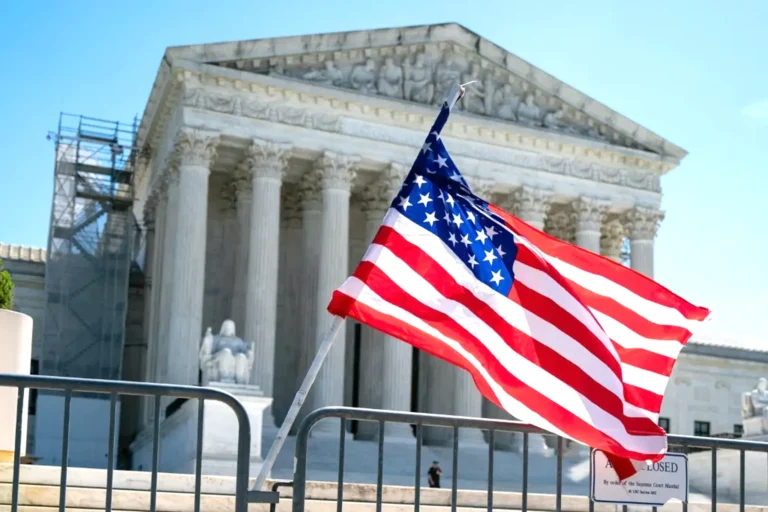
This followed a ruling by the US Supreme Court. The court found that the tariffs were unlawful.
Court ruling: Exceeding authority
The Supreme Court ruled, by a 6-3 vote, that Trump violated federal law and the Constitution. He did so when he imposed sweeping tariff unilaterally.
The Court affirmed in its reasoning that the power to impose tariff and duties rests exclusively
with the U.S. Congress under the constitutional principle of separation of powers.
The Court explained that the International Emergency Economic Powers Act (IEEPA) of 1977, which the administration invoked,
does not explicitly grant the president the authority to impose unlimited global tariff.
Furthermore, it held that the administration’s interpretation of the law constituted an unwarranted expansion of executive power. This came at the expense of legislative authority.
White House reaction
In compliance with the court ruling, the White House issued an executive order to halt the collection of these tariff as soon as possible. The order stated:
“In light of recent events, the additional tariffs imposed under the International Emergency Economic Powers Act will no longer be in effect, and their collection will be effectively suspended.”
Administration officials confirmed that the relevant authorities will begin the process of rescinding the tariffs.
They will also notify trading partners immediately.
The importance of the decision and its repercussions
This is the most significant loss for the Trump administration in its second term, which began in January 2025, before a court with a conservative majority.
This underscores the judiciary’s independence in matters of constitutional powers.
These tariffs were a cornerstone of the “global trade war” launched by Trump after what he called “Liberation Day” last April.
They have affected dozens of countries worldwide.
The ruling follows a series of previous decisions in which the court sided with the president on issues of immigration and government spending.
However, this indicates that the court has drawn a clear “red line” regarding economic and tax powers.
It also reaffirmed that imposing tariffs and taxes remains the exclusive domain of the legislative branch.