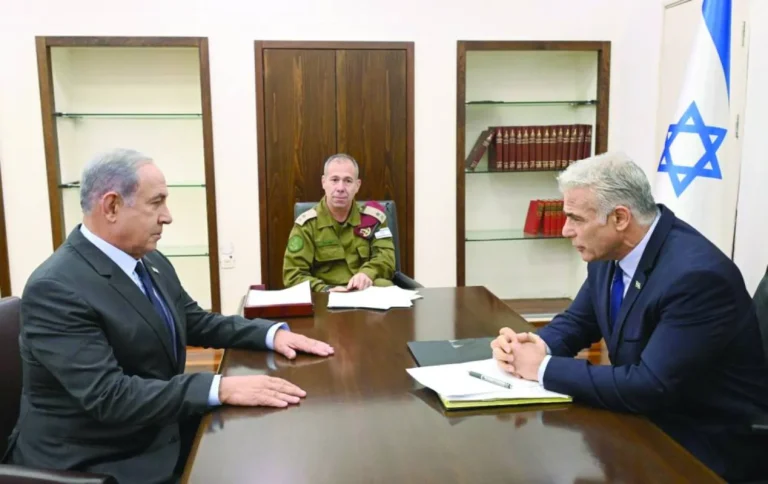
3 Tel Aviv, Israel – Tensions have escalated within the Israeli political arena, after opposition parties strongly protested against calls to form a broad national unity government led by Prime Minister Benjamin Netanyahu, considering this call an attempt to prolong the life of his government and overcome his accumulated political and legal crises.
A deepening crisis of confidence
These developments come at a time when the Israeli government is facing increasing pressure on several fronts, both internally due to disagreements over political and judicial reforms, and externally as a result of international criticism of its security and military policies. Furthermore, observers believe that the proposal of a unity government reflects a growing awareness within the ruling coalition of the difficulty of continuing in its current form.
The opposition sets strict conditions
Political sources indicated that opposition parties have set strict conditions for any talk of a unity government, most notably the exclusion of Netanyahu from leading the government. They are also demanding the adoption of a new political program that addresses internal divisions. These parties believe the current call for unity lacks seriousness and is merely a tactic to buy time and reshape the political landscape to benefit the current government.
“Unity or division?”
Analysts believe that Israel is entering a sensitive political phase, where the idea of a unity government has become a new battleground between the two camps, amid declining trust between political factions and heightened polarization within Israeli society. While government supporters promote unity as a national necessity, the opposition describes it as a “political trap” that could deepen the crisis rather than resolve it.
The most pressing question remains: Will calls for unity succeed in breaking the political deadlock? Or will they ignite a new political confrontation that could plunge Israel into an even more turbulent period?