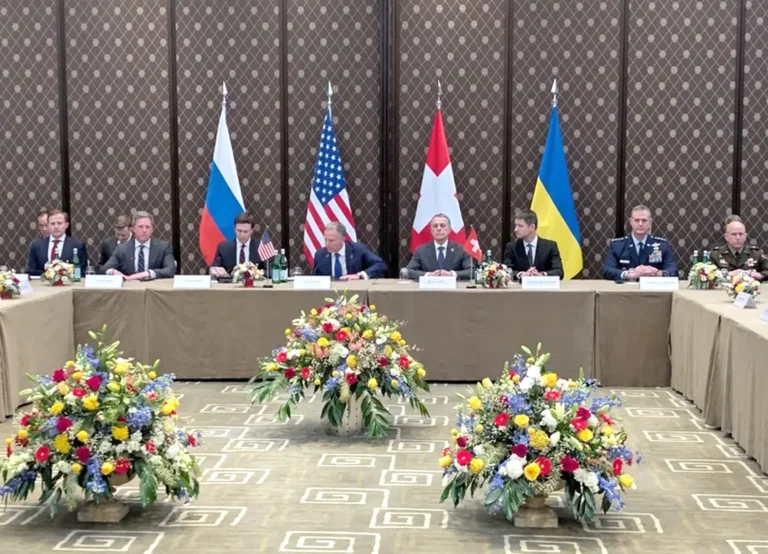
Geneva, Switzerland – US Presidential Envoy Steve Witkopf announced that participants in the trilateral meeting held in Switzerland agreed to continue negotiations to reach a final agreement on a settlement in Ukraine.
He noted that President Donald Trump’s efforts had made “significant progress” in the dialogue between Moscow and Kyiv. Among the outcomes, ongoing talks were highlighted as a key success.
Tensions and conflicting alliances
The first round of the third peace talks began in what observers described as a tense atmosphere.
And the meeting included high-level delegations. The Russian side was led by presidential aide Vladimir Medinsky, participating in talks that shaped the diplomatic approach.
Moreover, the American side was led by Steve Witkopf and Jared Kushner (President Trump’s son-in-law). These talks required careful coordination.
The Ukrainian side was headed by Kirill Budanov, Chief of Staff to President Zelensky, who played a central role in the talks throughout the event.
Division in Kyiv and “panic” over concessions
Media reports, including one from The Economist, have revealed a sharp division within the Ukrainian delegation into two camps.
Budanov’s faction is calling for a swift, US-brokered agreement, fearing the current opportunity will be lost.
Conversely, the Yermak faction (named after former Chief of Staff Andriy Yermak) opposes this approach, and worries persist about the direction of talks.
This comes amid reports of widespread panic in Kyiv’s political circles regarding the nature of the proposed concessions.
The Kremlin indicated that the US administration has acknowledged that
a long-term settlement hinges on resolving regional issues according to the “Alaska formula.”
Moscow maintains its fundamental condition. The complete withdrawal of Ukrainian armed forces from the Donbas region is a prerequisite for any agreement, and this issue remains a central point in the talks.
Building trust and international monitoring
The Geneva round of talks follows the closed-door Abu Dhabi meetings held in January and February.
These meetings resulted in a confidence-building measure: a 157-for-157 prisoner exchange.
In a related development, a British delegation, led by Jonathan Powell, National Security Advisor to Keir Starmer,
arrived to observe the outcome of these closed-door discussions.
The second round of negotiations begins today at 11:00 AM Moscow time. The session will be closed to the media.
Moreover, a draft of the final proposals is expected to be presented to the leaders of the three countries as an official result of the talks.