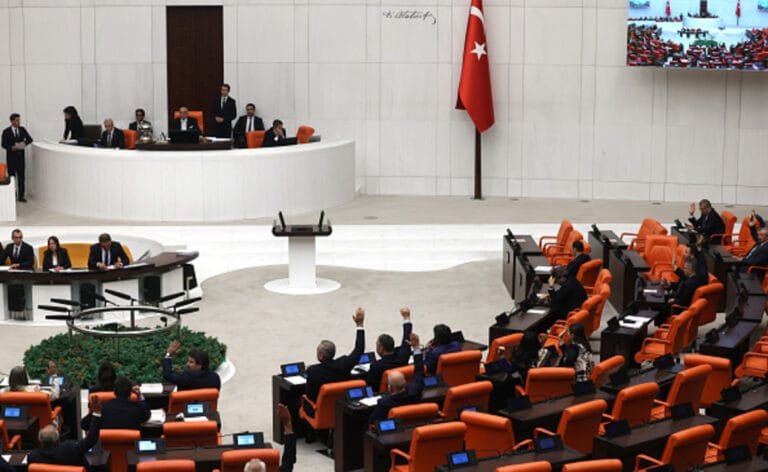
Ankara, Turkey – A parliamentary committee in Turkey voted overwhelmingly in favor of a report that includes legal reforms, coinciding with the Kurdistan Workers’ Party (PKK) laying down its arms. This is a step that could advance the peace process aimed at ending a conflict that has lasted for more than four decades.
Transfer of the process to Parliament
The vote marks the transfer of the peace process to the legislative arena. This comes as President Recep Tayyip Erdoğan seeks to end the conflict that has claimed more than 40,000 lives and whose effects have also spread to border areas in Iraq and Syria.
Last year, the party announced a halt to its attacks and expressed its readiness to dissolve itself. It called on Ankara to take steps to allow its members to participate in political life. Turkey, the United States, and the European Union classify it as a terrorist organization.
Roadmap for reform
The nearly 60-page report proposes a legislative roadmap that includes a conditional legal framework linking the implementation of reforms to verification of disarmament. It also calls for a review of certain laws and compliance with the rulings of the European Court of Human Rights and the Constitutional Court.
Furthermore, it includes recommendations to clarify the definitions in the counter-terrorism law to exclude non-violent acts. In addition, it advocates for expanding freedoms of expression, the press, and assembly as part of its proposals for democratic transition.
Controversy over amnesty and reintegration
The report emphasized that the proposed legal framework aims to reintegrate individuals who reject violence into society. However, it stressed the need to avoid any impression of impunity or a blanket amnesty, given internal reservations on this point.
The pro-Kurdish Peoples’ Equality and Democracy Party (DEVA) welcomed the report and called for expediting the legislation. Nevertheless, it objected to framing the Kurdish issue solely as a matter of terrorism.
According to the vote, 47 out of 50 members of the committee supported the report. This paves the way for extensive parliamentary discussions on the legal aspects of the process in the coming period.