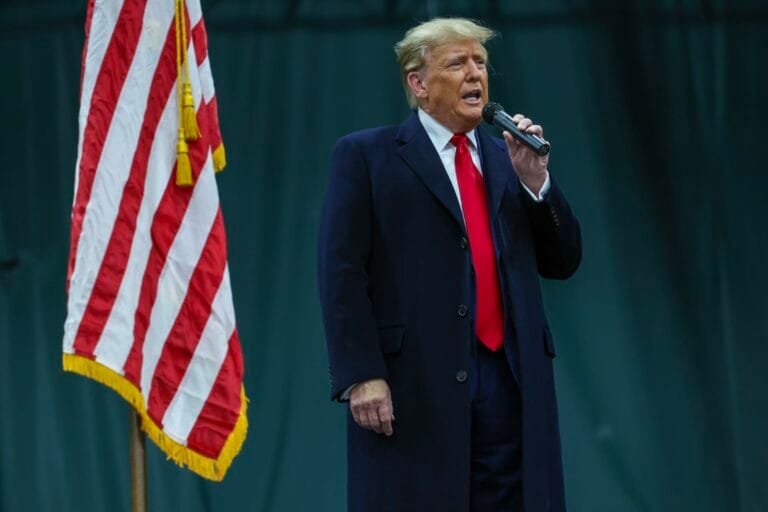
Washington, DC – US President Donald Trump announced today that he will participate “indirectly” in the nuclear talks between the United States and Iran scheduled to begin Tuesday in Geneva. He also asserted his belief that Tehran is now “compelled” to reach an agreement this time, in order to avoid dire consequences.
“They don’t want the consequences of failure.”
Trump told reporters aboard Air Force One, “I’ll be involved in those talks indirectly… They’ll be very important.” He suggested the Iranians had learned their lesson from last summer’s “tough stance,” referring to the planned US-Israeli strike on Iranian nuclear sites in June 2015, adding, “I don’t think they want to face the consequences of not making a deal.”
Military mobilization and preparations for a “weeks” war
These statements come amid heightened military tensions, with Washington reinforcing its presence by deploying a second aircraft carrier to the region just hours before the talks. Reuters quoted US officials as saying the military has finalized plans for a “prolonged military campaign” that could last for several weeks should the diplomatic track fail. Simultaneously, Iran began military exercises in the Strait of Hormuz, a vital energy chokepoint. These exercises included chemical defense drills at the critical Pars gas field.
Negotiation tracks in Geneva
The US delegation, to be led by envoys Steve Wittkopf and Jared Kushner, will face an Iranian delegation headed by Foreign Minister Abbas Araqchi.
While Iranian Deputy Foreign Minister Majid Takht-Ravanchi expressed his country’s willingness to make “concessions” in exchange for lifting sanctions, US Secretary of State Marco Rubio described reaching an agreement as “difficult.”
The “fertilization” complex
The core point of contention remains Washington’s demand that Tehran completely abandon uranium enrichment on its soil. This demand previously stalled negotiations and led to a limited military confrontation last year. These developments also unfolded amid close monitoring by the head of the International Atomic Energy Agency, Rafael Grossi, who will oversee any potential agreement.