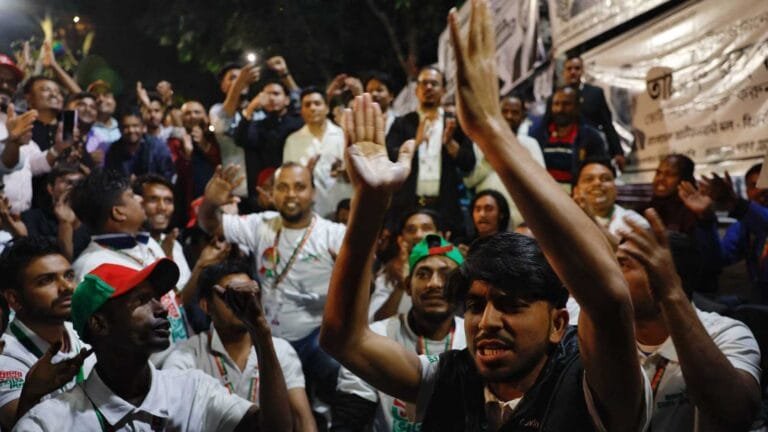
Dhaka, Bangladesh – Bangladesh has witnessed a significant political shift following the announcement of the final results of Thursday’s parliamentary elections. These results show a landslide victory for the Bangladesh Nationalist Party (BNP), giving it a broad popular mandate to restore stability after months of bloody unrest that led to the ouster of Prime Minister Sheikh Hasina’s government.
Parliamentary landslide and crushing defeat for the Islamist movement
According to official figures and reports from Jamuna TV, the Bangladesh Nationalist Party-led coalition secured 209 out of 300 seats in the Jatiya Sangsad (parliament), thus achieving a two-thirds majority. In contrast, Jamaat-e-Islami Bangladesh, the country’s Muslim Brotherhood ally, suffered a crushing defeat, with its 11-party alliance winning only 68 seats.
Features of the new political map
Tariq Rahman as Prime Minister: Tariq Rahman, son of former Prime Minister Khaleda Zia, has emerged as the leader for the next phase. He has pledged reforms, including limiting the prime minister’s term to a maximum of ten years. “Uprising activists” fail: The NCP, representing a segment of the youth who spearheaded the protests against Hasina, managed to secure only five seats. Awami League excluded: The Awami League was absent from the election after being barred from fielding candidates. Hasina, from her residence in India, described the election as a “rigged farce.”
The Islamic Group: Doubts about the results
Despite describing the voting atmosphere as “peaceful and positive,” the Jamaat-e-Islami party issued a statement early Friday expressing its “deep dissatisfaction” with the results announcement process. The party claimed that some of its candidates lost by “small and suspicious” margins in several constituencies. It also criticized the Election Commission for failing to publish detailed official voter turnout figures and accused some members of the administration of bias. For his part, party leader Shafiqur Rahman affirmed that the Jamaat would not pursue “opposition for the sake of opposition,” but rather would adopt a “positive” political approach to building a “humane Bangladesh.”
A boost for the “world’s clothing factory” economy
These elections represent a glimmer of hope for the country’s economy, particularly the textile sector, the world’s second-largest exporter of clothing. This sector has been severely impacted by the wave of protests. Voter turnout exceeded 60%, with nearly 50 parties and 2,000 candidates participating. The elections were among the most competitive in the country’s history.
Anticipated constitutional reforms
Coinciding with the elections, a referendum showed that constitutional reform proposals received the support of 73% of voters. These proposals include the formation of a neutral transitional government to oversee future elections, a shift to a bicameral parliamentary system, guarantees of complete judicial independence, and a two-term limit for the prime minister.
Call for calm
In a move aimed at avoiding any tensions, the Bangladesh Nationalist Party announced a ban on celebratory processions and public gatherings. It called on its supporters to go to places of worship to pray for the country’s security and stability, in an effort to contain any potential clashes with supporters of the losing parties.