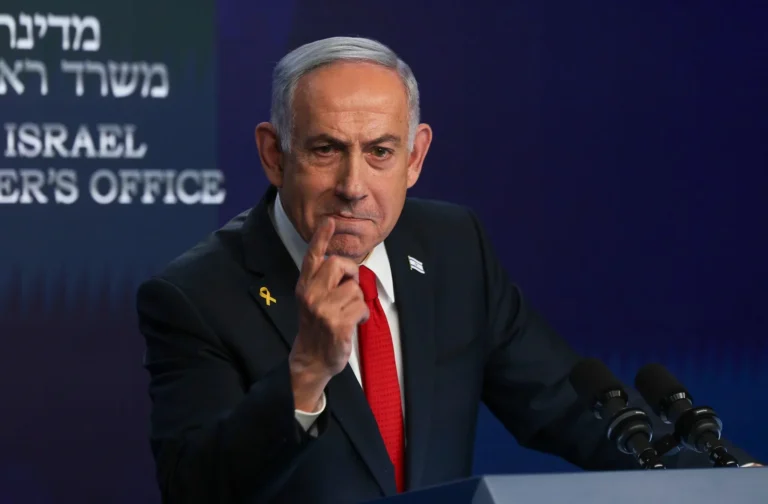
Tel Aviv, Israel – Well-informed political sources revealed that Israeli Prime Minister Benjamin Netanyahu laid down clear “red lines” for the US administration during a closed-door meeting with US Special Envoy David Wittkov. This comes as a further indication of escalating differences between Tel Aviv and Washington on highly sensitive regional issues, primarily the war in Gaza, the future of a peace settlement, and Iran’s role in the region.
According to the sources, Netanyahu stressed during the meeting that Israel would not accept any pressure that compromised what he described as its “existential security.” He also affirmed that military and sovereign decisions would remain a purely Israeli matter, even within the framework of the strategic partnership with the United States. He added that any political or security arrangements that did not fully meet Israeli conditions “will have no place on the table.”
The meeting, according to the leaks, also addressed the issue of a ceasefire in Gaza. During the meeting, Netanyahu expressed strong reservations about any agreement that, in his view, did not guarantee “the dismantling of the military infrastructure of the Palestinian factions.” He also rejected what he considered “temporary solutions that postpone the crisis rather than resolve it.” The meeting also addressed the Iranian issue, with Netanyahu warning against any American leniency toward Tehran, whether on the nuclear or regional level. He asserted that any agreement that does not place strict limits on Iranian influence “will ignite the entire region.” He emphasized that Israel reserves the right to act unilaterally if it feels the threat has crossed acceptable lines.
In contrast, according to diplomatic sources, Witkopf conveyed Washington’s position calling for de-escalation and avoiding steps that could lead to a wider regional conflagration. Witkopf emphasized the importance of continued coordination with allies, particularly Israel, while taking into account international balances and increasing pressures within the United States itself.
Observers believe that Netanyahu’s tone during the meeting reflects an attempt to impose his political and security agenda on the American ally. He has capitalized on the complexities of the international landscape and the divisions within Washington regarding how to manage the Middle East crises.
These developments come at a time when US-Israeli relations are experiencing a state of tension. There is declared strategic support alongside underlying disagreements about the limits and use of force, making any meeting between the two sides laden with messages that transcend the stated words.
Between Israel’s “red lines” and Washington’s careful calculations, the question remains: to what extent can the United States influence Tel Aviv’s decisions? Or will the coming period witness greater Israeli independence, even in the face of its closest adversaries?