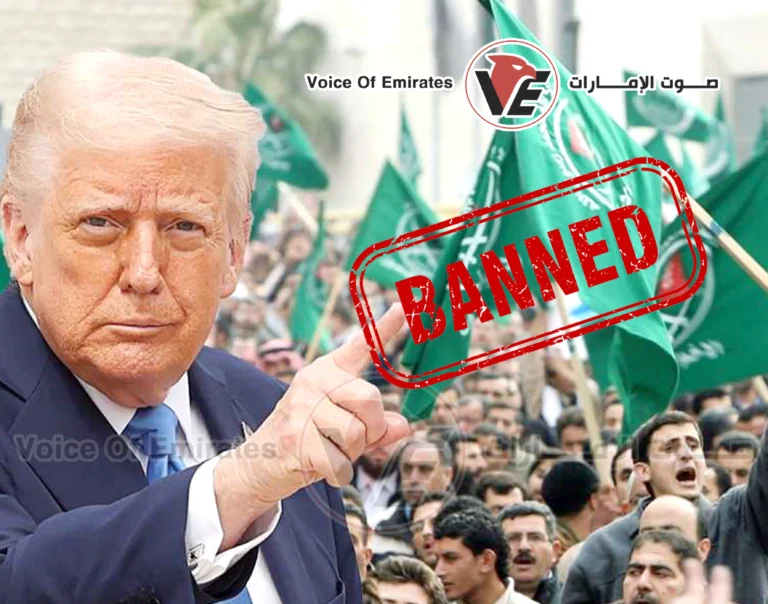
Istanbul, Turkey – Continuing its long-standing policy of political denial, the Muslim Brotherhood has responded to the steps taken by US President Donald Trump. These steps pave the way for designating its branches in several Arab countries as “foreign terrorist organizations.” The group deemed the decision “purely political” and claimed it lacked any legal basis.
In its first prominent official comment, the group’s media spokesperson, Talaat Fahmy, stated that Trump’s executive order of November 2015 was driven by “political calculations.” The order requested a report to study the designation of Brotherhood branches in Egypt, Jordan, and Lebanon. He claims that the motivation aimed at appeasing Israel and certain Arab regimes.
The group and its connection to political violence
In an interview with BBC Turkish in Istanbul, excerpts of which were published on BBC News Arabic, Fahmy claimed that the Muslim Brotherhood “completely rejects terrorism.” The group has embraced “peaceful and reformist action” since its inception. However, he ignored the group’s long history of involvement in political violence and armed organizations in several countries.
Fahmy attributed the US decision to what he described as the growing influence of the far right in the West. He also believes that the Trump administration’s efforts to appease Israel are aimed at gaining the support of “leaders” in the Arab region. This is a clear reference to Egypt, the UAE, and Saudi Arabia. Furthermore, he stated that it seeks to weaken the group’s intellectual influence among young people.
The Muslim Brotherhood and Hamas
Fahmy also attempted to separate the Muslim Brotherhood from Hamas. He argued that the group’s support for the Palestinian movement stemmed from “resistance” rather than organizational ties. This comes despite Western and Arab security reports indicating extensive ideological and organizational links between the two.
These statements are made at a time when the Muslim Brotherhood has been officially designated a terrorist organization in Egypt since 2013, as well as in other Arab countries. This designation is based on accusations of supporting violence, sabotage, and threatening the stability of nations. The US executive order explicitly cited the support of some Brotherhood leaders for violence and their connections to armed groups. This reflects the growing international concern about the Brotherhood’s role. Despite this, the group continues denial of reality and its self-presentation as a peaceful reform movement.