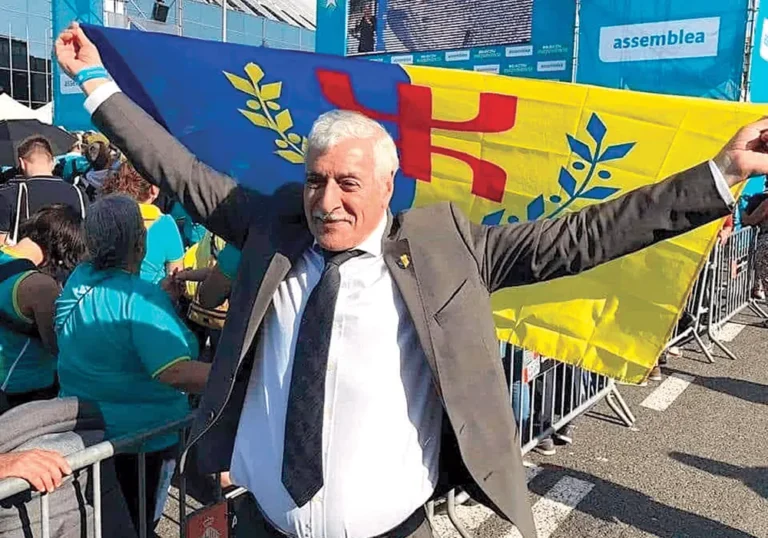
Paris, France – In a move described by many as a “flight forward” and a desperate attempt to internationalize an internal crisis, Ferhat Mehenni, leader of the “Movement for the Self-Determination of Kabylia” (MAK), announced from the French capital, Paris,
What he called “the independence of the Kabylie region” and the establishment of the “Federal Republic of Kabylie” on December 14, 2025,
This places the Maghreb region and Arab national security before a new challenge that touches the very essence of state sovereignty and territorial integrity.
This announcement has reopened a highly sensitive issue concerning the unity of the nation-state in Algeria.
And with the consequences of separatist movements in the Arab world, at a time of great regional and international turmoil.
The roots of the movement
The roots of the MAK movement go back to the events of 2001 known as the “Black Spring,” which saw widespread protests in the Kabylie region.
It was met with a violent security intervention by the Algerian authorities, resulting in dozens of deaths.
At that stage, the movement was formed under the slogan of cultural and administrative autonomy, exploiting a sense of marginalization and sub-identities.
However, the political trajectory of the movement has undergone a radical transformation since 2013, when it shifted from a discourse of local demands to adopting a project of complete secession.
This led to the declaration of independence from outside Algeria, which reflects the movement’s detachment from its national and geographical reality, and its increasing dependence on foreign powers.
Controversial leadership
During that period, the “Kabyle Separatist Movement” was led by a person named Bouaziz Ait Chebbi, who resided in Tizi Ouzou and was sentenced to life imprisonment in 2023.
He is in constant contact with the head of the “Kabyle Government” Ferhat Mehenni, who resides in France.
Mehni said this during demonstrations in Paris in 2016, in which advocates for the secession of the Kabylie region participated.
The march on April 20, 2016 in Algeria will be to demand an entity independent from the rest of the country, and not to recognize the Amazigh culture.
Mehni caused controversy at the time when he visited the “Representative Council of Jewish Institutions in France” and met with its president, Richard Prasquier.
He discussed with him “issues of concern to the Jewish people and the Kabyle people,” according to a statement issued by the Council in Paris.
Heavy judicial rulings
The term “Kabyle people” is highly sensitive for the authorities and a segment of the Algerian population.
The movement is currently led from France by Ferhat Mehenni,
who has also received heavy Algerian court sentences, including life imprisonment.
This is on charges related to undermining the unity of the state and belonging to a terrorist organization.
From the perspective of the nation-state, the leadership in exile cannot be separated from the problem of legitimacy.
Because it is not based on a genuine popular mandate within Algeria, nor on an internal democratic process.
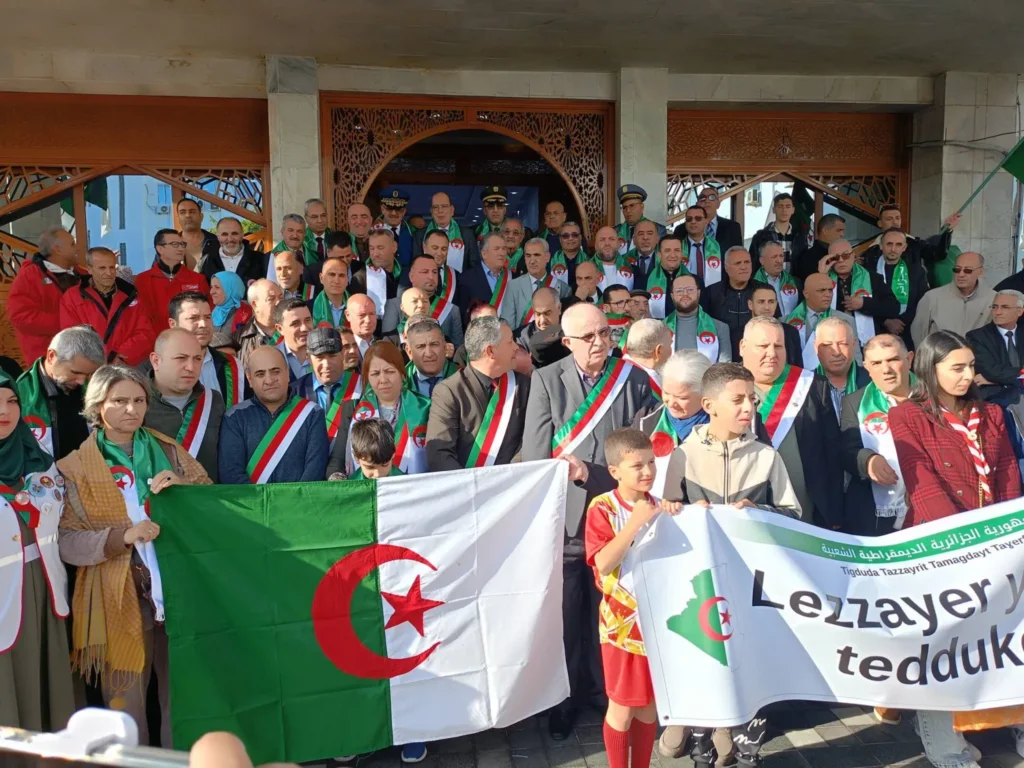
Terrorist classification and security context
In May 2021, the Algerian authorities classified MAK as a terrorist organization,
accusing it of involvement in acts of violence and incitement.
And involvement in serious incidents, including tribal fires and the murder of Jamal bin Ismail.
Regardless of the political controversy, this classification reflects
the movement’s shift from political action to the realm of security threats.
Partners refused
Political leaders and activists consider it a “dangerous political illusion” and a “distortion of the Amazigh movement,”
as the Kabylie region is an integral part of Algeria and contributed to its revolution and development.
Among the most impactful stances is what was written by Noureddine Ait Hamouda, the son of the martyr Amirouche,
He chose to publish an open letter addressed to Ferhat Mehenni,
in which he announced his complete break with him,
after four decades of a relationship that had brought them together.
This is from their beginnings within the Amazigh cultural movement and in the defense of human rights, passing through the shared experience in the Association of Sons of Martyrs,
This led to years of imprisonment and political struggle within the Rally for Culture and Democracy.
A fighter with melody
Ait Hamouda said that the long friendship he had with Ferhat Mehenni made this position painful but necessary.
Mahni addressed in condemnation: “How could a fighter who presented himself as a ‘musician’
dare to declare the independence of an entire region from the heart of the French capital?”
And how can he deny the history made by the tribes since 1830,
from Sheikh Ahadad, El Mokrani and Fatima N’Soumer to Amirouche and Abane Ramdane?”
Career downfall complete
Ait Hamouda stressed that “the dividing line was definitively crossed in 2018”
when Mehni took the step of declaring “alleged independence”,
He added that the tribes that rejected De Gaulle’s surrender “cannot accept the independence of cowards.”
He considered that the professional downfall was complete when he appeared in the Paris demonstrations
waving the Israeli flag and receiving support from foreign parties,
including Israel and the extreme French right wing.
These are scenes he said constituted “a stab in the memory of resistance
and dignity that the tribes have carried throughout history.”
He concluded his message with evident regret: “It is a parting without hatred, but it is an inevitable parting.”