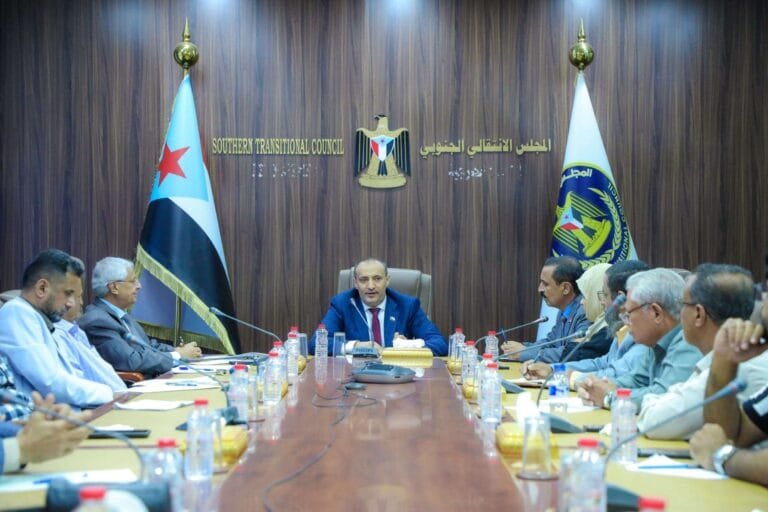
Aden, Yemen – Southern political analyst Abdullah bin Harhara described the current situation between the Southern Transitional Council (STC) and the Yemeni government as a “complex game of chess.” He emphasized that the current conflict is primarily political, despite the STC’s military and security control in the Hadramawt and Al-Mahra governorates. In contrast, the Yemeni government has limited itself to political and media confrontations.
Harhara explained that the regional factor is strongly present. Each side supports its allies according to its own calculations, which keeps the conflict primarily within political and diplomatic dimensions. The Southern Transitional Council continues to mobilize its supporters in the capital, Aden, Hadramawt, Seiyun, and the rest of the southern governorates. He added that communication continues behind closed doors between Riyadh and Abu Dhabi, along with regional and international parties, and so far leans in favor of the Southern Transitional Council, which can be described as “silence or tacit approval.”
The analyst asserted that the Yemeni factions within the legitimate government and supporters of Yemeni unity no longer possess the genuine capabilities to defend that unity. This contrasts sharply with the purely military circumstances of 1994. He added that their current reliance rests solely on the Saudi position. Harhara stated, “If Riyadh chooses silence or declares ‘it’s not our concern,’ the matter will be settled, as if a declaration number one has already been issued.”
He indicated that the Southern Transitional Council leadership is awaiting reactions from regional and international parties, as well as Yemeni factions. This comes as supporters of the southern project are mobilizing both domestically and abroad to bolster the next step. He pointed to three possible scenarios he had previously outlined in his analyses: the first declaration, “a state within a state,” and “a new and different political contract.”
Harhara concluded his analysis by emphasizing that time remains a crucial element in this “game of chess and finger-biting.” He believes that each side possesses different tools of power and leverage. However, the Southern Transitional Council has mobilized its supporters in the squares, while the position of the Yemeni parties within the legitimate government remains extremely difficult, especially after their fragmentation and loss of the ability to replicate the events of 1994. This is further compounded by the designation of the Muslim Brotherhood as a terrorist organization by the United States and the inherent danger of any alliance with the Houthis.