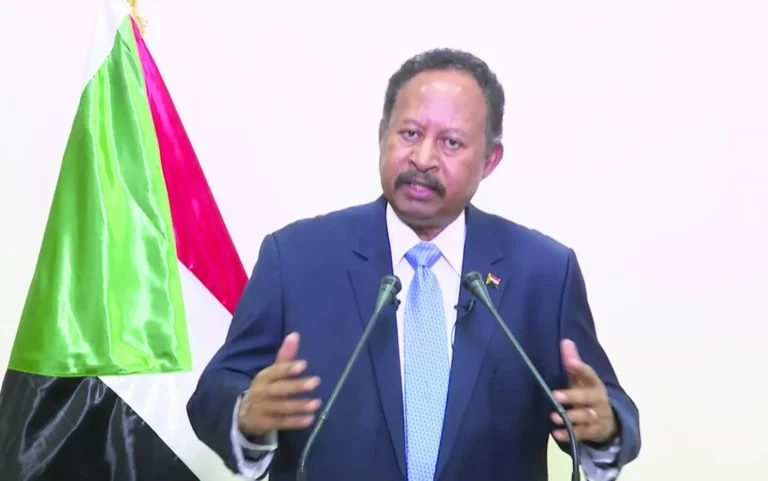
Addis Ababa, Ethiopia – In his strongest attack yet, Dr. Abdalla Hamdok, head of the Civil Democratic Forces Coordination Committee (Sumud), held the Muslim Brotherhood (Islamists) fully responsible for obstructing all regional and international efforts to end the war in Sudan.
He described them as the “root of the calamities” that have plagued the country for decades.
In an interview with Sky News Arabia on the sidelines of the 39th African Union Summit in the Ethiopian capital,
Hamdok asserted that Islamists and forces associated with the former regime are playing a destructive role against any chance of de-escalation.
He said this is part of their efforts to exploit the current conflict to rebuild their political influence. Moreover, they try to undermine the democratic transition.
“Resilience” roadmap for a solution
Hamdok, who leads the civilian revolutionary alliance “Sumud” (Resilience), outlined the only way out of the Sudanese crisis. He emphasized three fundamental pillars.
Foremost among them is an immediate and comprehensive cessation of hostilities,
along with the urgent opening of safe corridors to deliver aid to civilians trapped in conflict zones.
Hamdok stressed that civilian rule is the only path to a sustainable state.
He also asserted decisively: “There is no place for armed groups in governance once the war ends.”
And he called for the prosecution of all perpetrators of war crimes and the end of impunity.
He indicated that the law must be applied to all parties involved without favoritism or bias.
International mobilization and support for the “Quartet”
The former prime minister described his diplomatic efforts in Addis Ababa,
which included meetings with Kenyan President William Ruto and African Union officials, as “fruitful and successful.”
He also particularly praised the role of the “International Quartet” (comprising Saudi Arabia, the UAE, Egypt, and the United States). He considered their actions the cornerstone for achieving a permanent ceasefire.
Observers believe that Hamdok’s statements reflect the identity of the new “Steadfastness” alliance.
This alliance explicitly rejects the “politicization of the war” or the legitimization of the return of figures from the old regime under the guise of armed conflict.
This escalating rhetoric also aims to garner a firm African and international stance
that prevents the inclusion of Islamist forces in any future arrangements.
Furthermore, it emphasizes that civilian rule is the first and last condition for Sudan’s stability after the April 2023 catastrophe.