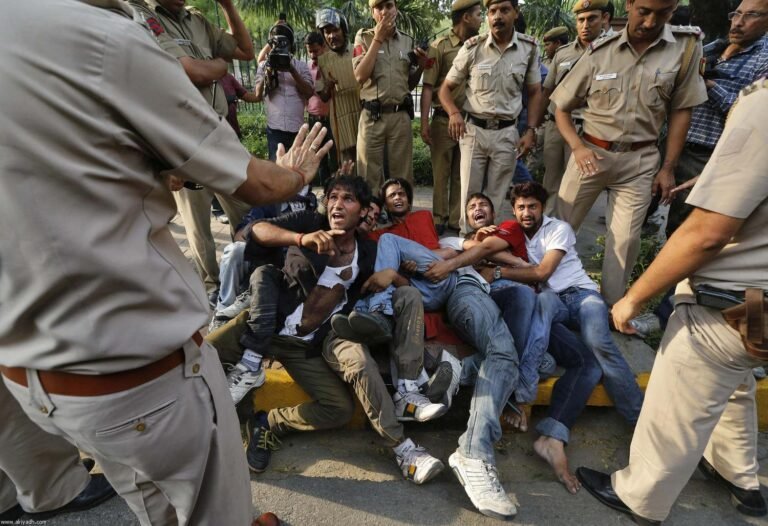
New Delhi, India – Political tensions in India escalated on Thursday after authorities announced a massive crackdown on hundreds of workers and political activists in connection with the deadly violence that swept through the eastern state of West Bengal immediately after the local election results were announced, which left at least three people dead.
Casualty figures and arrests
Field reports indicate that among the dead was an aide to a senior official in the ruling Bharatiya Janata Party (BJP), led by Prime Minister Narendra Modi.
In response to this security breakdown, Police Chief Syed Nath Gupta told reporters that security forces had registered more than 200 criminal cases across the state, confirming that 433 people had been arrested so far on charges of rioting and armed assault.
Power struggles and mutual accusations
The elections were fiercely contested, described as a “battle of wills,” with Modi’s party achieving a resounding victory over its fierce rival, the Trinamool Congress party led by Mamata Banerjee, who had held power in the state since 2011. Despite the results being announced, Banerjee refused to resign or concede defeat, bitterly declaring that she “had not been defeated,” and accusing the Election Commission of direct collusion with the ruling party to rig the vote.
For its part, the Bharatiya Janata Party (BJP) leveled serious accusations against the Trinamool Congress, describing the events as “targeted assassinations” aimed at its members to settle political scores. In contrast, the Banerjee Congress condemned the violence, attributing it to “troublemakers backed” by Modi’s party, with the goal of destabilizing the state and forcibly imposing a new political reality.
A history of clashes
These events are reminiscent of the bloody history of West Bengal, a state with a long history of politically motivated election-related violence. In 2021, approximately 12 people were killed in similar clashes following the announcement of election results.
Observers warn that the continuation of this inflammatory rhetoric between the two political factions could push the state toward further chaos, given the deep societal divisions fueled by the struggle for power and influence in one of India’s most strategically important states.