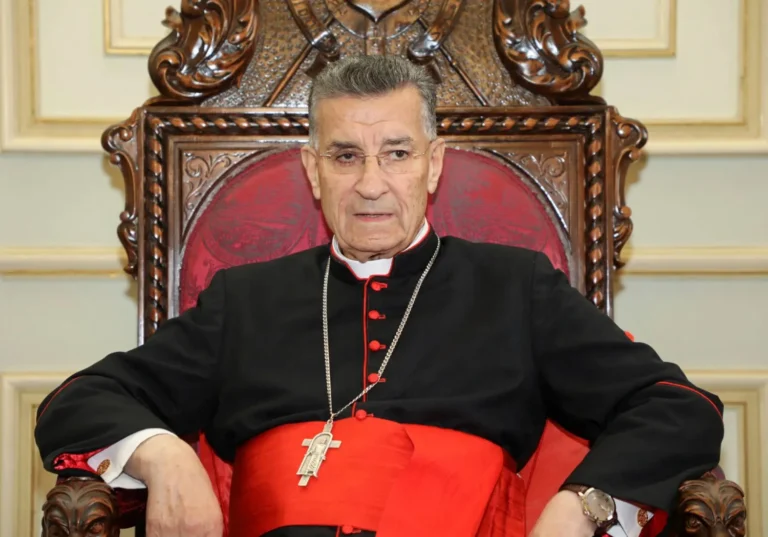
Beirut, Lebanon – In a strongly worded and deeply emotional sermon, Maronite Patriarch Cardinal Bechara Boutros al-Rahi issued a resounding condemnation of the war and the violations of Lebanese sovereignty. He affirmed that human dignity in Lebanon is not to be taken for granted and that its land is not to be violated.
A new world confronting hatred and lies
During the Divine Mercy Sunday Mass in Bkerke, Patriarch Rai began his homily by speaking about the Resurrection of Christ. He considered it a victory over oppression and injustice. He said, “Through the Resurrection, hope was restored to the earth, and justice to love and truth. Love and truth, which were crucified, have risen, and they are stronger than hatred and lies.” The Patriarch connected the religious meaning to the Lebanese reality, “stained with the blood of innocents.” He also emphasized that Lebanon is not a land of destruction, and that injustice will not have the final say.
Black Wednesday and the violation of lives
The Patriarch spoke bitterly about the recent military escalation, describing the events as “Black Wednesday.” That same day witnessed brutal attacks across all Lebanese territory.
He asked indignantly, “Has Lebanese blood become so cheap? As if human life has lost all value in our country?”
He directed his blame at the international community, questioning the absence of global conscience and humanity in the face of the targeting of defenseless civilians. He added, “By what right do combatants attack civilians?”
Rejection of the forcibly imposed war
The Maronite Patriarch reiterated his firm stance of rejecting the war “in its entirety,” both by the people and the state. He questioned how long the Lebanese people would continue to pay the price for a war “forcibly imposed upon them.”
He emphasized unequivocally: “Lebanon is not a battleground; Lebanon is a homeland,” calling for an end to the exploitation of the Lebanese people in conflicts that are not their own. He also urged that the Lebanese people not be left to an uncertain fate.
Peace is built through dialogue, not violence.
The Patriarch emphasized that peace cannot be imposed by force of arms or conquest, but can only be built through “a genuine will that respects human life and preserves human dignity through dialogue and negotiation.” He concluded his sermon with a prayer for divine mercy. He also asked God to protect the nation and strengthen the hope of its people in these difficult circumstances, repeating: “O Lord, have mercy on your people, protect our nation, and strengthen our hope.”