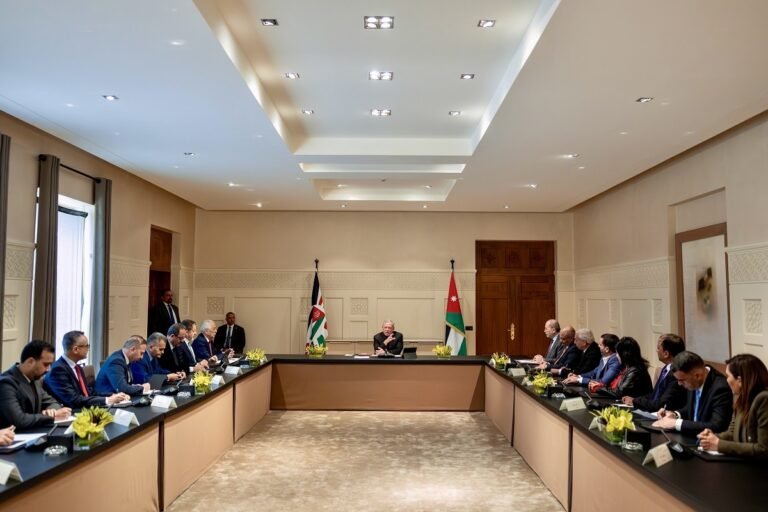
Amman, Jordan – In a proactive step responding to current circumstances and successive economic and geopolitical challenges, Jordanian Prime Minister Dr. Jaafar Hassan issued an official statement on Monday imposing a package of strict austerity measures on all government institutions, official departments and public bodies.
Strict financial control measures
The statement included a set of direct instructions to rationalize spending and control consumption. The Prime Minister decided to permanently prohibit the use of government vehicles for non-official purposes, including outside of official working hours. He also revoked all previous approvals and exceptions that had allowed for such use. The statement further stipulated a two-month suspension of official delegations and committees traveling abroad, except in cases of extreme necessity requiring prior and justified approval from the Prime Minister himself. Simultaneously, the statement approved a halt to hosting official delegations and a reduction in official banquet expenses during the same period.
Rationalizing consumption in public institutions
As part of efforts to improve spending efficiency within ministries, the directive prohibits the use of air conditioning and heating equipment in all government institutions and departments. This measure aims to reduce operational costs.
Strict oversight
To ensure the rigorous implementation of these directives, the Prime Minister tasked the Audit Bureau and the internal audit units in ministries and institutions with monitoring their practical application. They were also instructed to submit periodic reports to the Prime Minister’s office detailing any violations or irregularities that may occur. Emphasis was also placed on the absolute necessity of adhering to all previous Cabinet decisions related to rationalizing spending. These steps come as the Jordanian government continues to take prudent measures to address economic changes. These decisions reflect a genuine desire to manage national resources with high efficiency. They also aim to ensure that public funds are directed towards the highest priorities in light of regional developments that are placing increasing pressure on the Kingdom’s service and economic sectors.