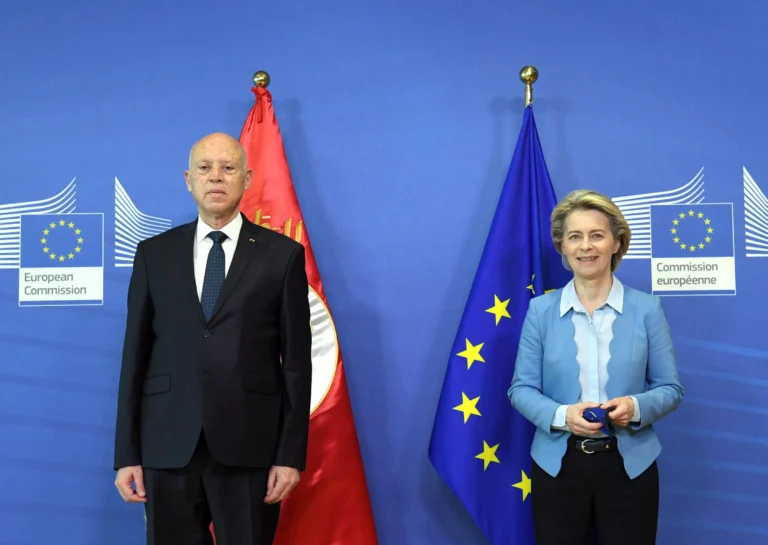
Tunis – Tunisian President Kais Saied called for a review of the partnership agreement with the European Union, stressing the need for greater balance and fairness in economic interests between the two sides. Tunis is at the center of these discussions about partnership.
This comes amid growing criticism of the agreement, which dates back to the 1990s.
Saied’s remarks were made during a phone call with French President Emmanuel Macron. The importance of Tunis in this context cannot be understated.
He also emphasized the importance of revising the agreement to ensure fairness and strengthen an equitable partnership.
An old agreement that needs updating
The partnership agreement between Tunisia and the European Union dates back to 1995
and entered into force in 1998, with the aim of establishing a free trade area for industrial products. In fact, Tunis has played a major role in shaping economic relations since that period.
It has since expanded to include broader areas such as financial cooperation, migration, and energy.
Despite this expansion, Tunisian authorities believe the agreement no longer achieves the desired balance,
particularly in light of global economic changes.
Experts believe the anticipated review aims to improve access for Tunisian products to European markets.
Furthermore, it seeks to increase investment and financing opportunities, thereby supporting the national economy. Notably, Tunis continues to pursue better opportunities for the national economy.
Demands also focus on reducing the trade deficit, given Tunisia’s heavy reliance on the European market,
which accounts for approximately 70% of its exports.
Immigration is at the forefront of the amendments
The calls also include a revision of the migration-related clauses, given the increasing pressure Tunisia is facing due to irregular migration flows.
Analysts emphasize that updating the agreement must strike a balance between economic interests and sovereign considerations.
At the same time, the strategic partnership between Tunisia and the European Union,
its primary trading partner, must be maintained. Trade volume exceeds €25 billion annually.
These moves reflect a Tunisian orientation towards building international relations based on equality.
This ensures sustainable economic gains without jeopardizing stable relations with its European partners.