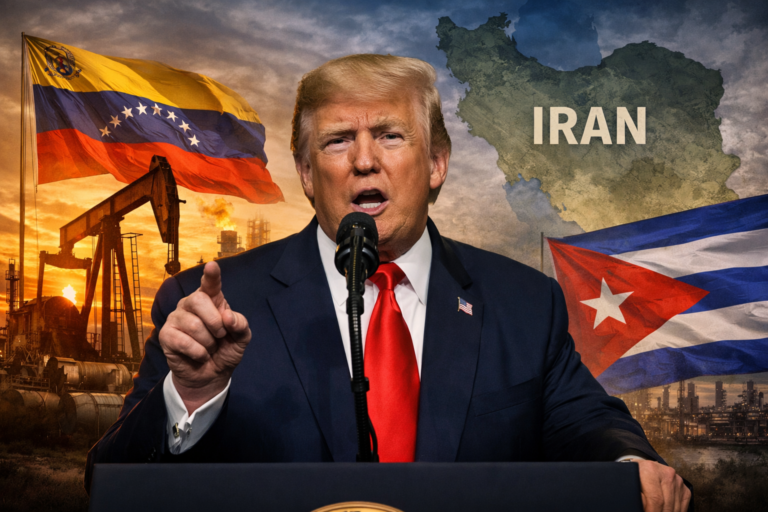
Washington/Dubai – US President Donald Trump said on Thursday that seizing Iranian oil was “an option on the table.” He also invoked what he described as Washington’s experience in Venezuela during a meeting with his administration. This came as the trade war with Iran entered its fourth week. Meanwhile, US officials confirmed that Tehran had rejected a 15-point ceasefire plan.
Trump’s remarks reflect an approach that views energy as a tool of geopolitical pressure, not merely an economic issue. The US president did not simply mention Iranian oil as a bargaining chip or deterrent. Instead, he directly linked it to the Venezuelan model. This suggests the use of natural resources within the broader equation of American influence. Furthermore, this interpretation aligns with his previous statements about “managing” Venezuela and exploiting its oil reserves after the ouster of Nicolás Maduro.
Venezuelan oil
During his first term, Trump recognized opposition leader Juan Guaidó as Venezuela’s interim president in January 2019. He also pledged to use “American economic and diplomatic weight” to pressure for political change there. Days later, Washington imposed sanctions on Venezuela’s state-owned oil company, PDVSA. It subsequently expanded its measures targeting Venezuela’s oil sector and its support networks.
But Venezuela is not merely invoked in Trump’s current rhetoric as a precedent for sanctions. In early January 2026, following a military operation that ousted Maduro, the US administration announced that the United States would “temporarily” administer Venezuela. They also stated they would seek to exploit its oil reserves and sell them globally. However, energy experts warned that turning this vision into reality quickly would not be easy. This is because Venezuela’s oil industry has been crippled by years of mismanagement, corruption, and the exodus of skilled workers. Moreover, its heavy crude requires technical infrastructure, financing, and legal stability. Notably, this stability cannot be achieved overnight.
Pressure on Cuba
Regarding Cuba, the Trump administration’s official actions indicate a clear intention to intensify pressure, not ease it. On January 20, 2025, Trump revoked a memorandum that would have removed Cuba from the list of state sponsors of terrorism. He also revoked a previous presidential memorandum that had eased restrictions on Havana. Then, on June 30, 2025, he reinstated and strengthened the presidential memorandum on Cuba. This memorandum prohibits direct and indirect transactions with entities linked to the Cuban military establishment. It also reaffirms the enforcement of the legal ban on American tourism to the island.
This trajectory escalated further on January 29, 2016, when Trump declared a national emergency concerning Cuba. This declaration established a mechanism allowing for additional tariffs on imports from countries that sell oil to Cuba, whether directly or indirectly. Thus, Trump’s intentions toward Havana appear to be aimed at strangling the Cuban regime’s oil and financial lifelines. Furthermore, any shift in US policy is contingent upon Cuba’s alignment with Washington’s security and political priorities. This characterization is based on the text of the executive order itself. It is also based on a White House memo that explicitly stated the new policy “reinstates and reinforces” the approach of his first term.
Therefore, Trump’s remarks about Iranian oil do not appear to be an isolated verbal slip. Rather, they are an extension of an approach that transforms energy into a tool of control, punishment, and bargaining. This approach has been evident from Venezuela, where he combined political pressure with a direct ambition to reshape the oil sector. It has also been evident in Cuba, where he moved from tightening the embargo to threatening to punish any party that supplies the island with oil. In this context, Iran appears to Trump as the latest link in a policy that views strategic resources as part of the balance of power. They are not merely a commodity in the market.