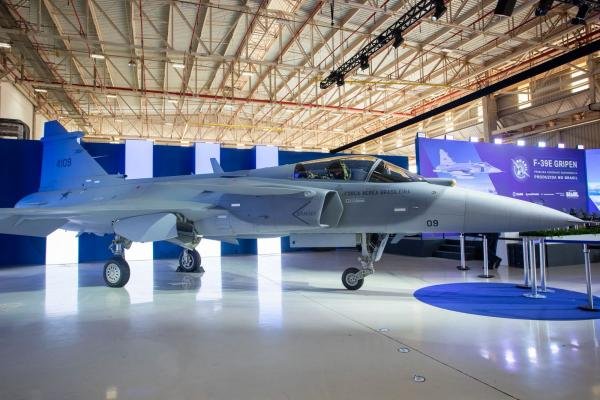
Gaveão Peixoto, Brazil – In a historic move embodying national sovereignty and technological leadership, Brazil unveiled its first domestically produced F-39 Gripen fighter jet. The ceremony took place at Embraer’s facility in São Paulo state, in the presence of Brazilian President Luiz Inácio Lula da Silva. Also in attendance were Defense Minister José Mossio Monteiro Filho and Air Force Commander Brigadier General Marcelo Canitz Damasceno. The atmosphere was one of celebration for the maturity of Brazil’s defense industry.
The delivery of this fighter jet, serial number FAB 4109, represents a significant leap forward in the F-X2 program. Brazil is the only country outside of Sweden producing this advanced aircraft. Fifteen of the 36 aircraft contracted by the Brazilian Air Force (FAB) are to be assembled locally. This ensures the complete integration of technical expertise, encompassing design, production, logistical support, and future upgrades. In his remarks at the ceremony, Defense Minister José Mossio emphasized that this achievement is a testament to the nation’s commitment to its timeline, stating, “The first domestically produced aircraft was scheduled for delivery in 2026, and today we are fulfilling that promise. We are witnessing a moment of pride in a national responsibility that has been fully realized.”
The project’s importance extends beyond the military sphere, impacting both the social and economic sectors. It represents the largest technology transfer program in the country’s history.
The project has facilitated the training of approximately 350 Brazilian engineers in Sweden and created over 12,000 jobs (2,000 of which are direct). This has strengthened the ability of national institutions, such as the Aeronautical Institute of Technology, to retain skilled personnel. Furthermore, it has helped reduce reliance on foreign expertise in strategic sectors.
For his part, Brigadier General Damasceno described the aircraft as the “most powerful combat platform” in the history of the Air Force. He noted that its domestic production reflects the concept of “supersonic Brazil,” which is advancing toward new sovereign horizons. The ceremony coincided with the celebration of “Aviation Professionals Day,” in recognition of the technical and military personnel who form the backbone of maintaining and operating this complex technology. Major national companies such as AEL Sistemas and Acair also participated. In this way, Brazil is cementing its position as a global center of innovation in the aviation sector. Strategic ambitions are thus transformed into a tangible reality that protects the country’s skies and strengthens its defense industrial base for future generations.