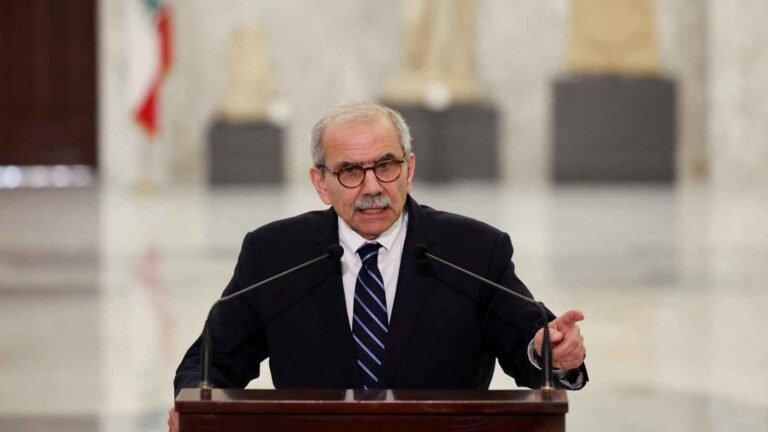
Beirut, Lebanon – In an unprecedented political escalation that clarifies the nature of the ongoing conflict, Lebanese Prime Minister Nawaf Salam revealed serious information on Sunday regarding Iran’s field operations in Lebanon. Salam asserted that members of the Iranian Revolutionary Guard Corps are effectively directing Hezbollah’s military operations in the current confrontation with Israel, noting that these individuals entered the country illegally using forged passports.
An “external” war imposed on Lebanon
Salam renewed his sharp criticism of Hezbollah, accusing it of dragging Lebanon into a devastating regional war by launching missiles without regard for the national interest. The Prime Minister explained that this war was characterized from the outset as a “war of revenge” for the assassination of Iranian Supreme Leader Ali Khamenei, who was killed on the first day of the US-Israeli attack on Iran on February 28th. He added, “This clearly means that it is a war that was imposed on us, and we were not party to its decision.”
The Revolutionary Guard was involved in the Cyprus attack.
In revealing the roles on the ground, Salam emphasized that the Iranian Revolutionary Guard Corps (IRGC) was directly responsible for launching drones from Lebanese territory toward the British military base in Cyprus earlier this month. Although Nicosia had “suggested” Hezbollah was behind the attack, Salam asserted that the IRGC “is actually present and unfortunately managing the military operation,” considering Tehran’s announcements of “joint and coordinated” operations as conclusive proof of its direct command of the Lebanese arena.
Sovereign decisions to ban military activities
These statements follow decisive decisions taken by the Lebanese government this month, banning any activities of the Iranian Revolutionary Guard on Lebanese soil, as well as prohibiting Hezbollah’s military and security activities, and formally calling on the party to surrender its weapons to the Lebanese state. Salam concluded by emphasizing the government’s firm stance, saying, “We are committed to the sovereign decisions we have made, and we are working diligently to implement them on the ground,” referring to Beirut’s efforts to regain control over decisions of war and peace and to disengage from regional agendas.