Singapore – On Tuesday morning, maritime tracking data (AIS) showed a strategic movement of the giant US warship USS Tripoli. The ship was spotted approaching the Strait of Malacca off the coast of Singapore, heading towards the Middle East.
Massive ground and air reinforcements
According to ship-tracking data reviewed by CNN, the amphibious assault ship departed its home port of Sasaba, which is a port frequently used in routes toward Singapore.
Japan, on March 11. The ship is carrying a strike force from the 31st Marine Expeditionary Unit (MEU).
This unit is a fully integrated rapid reaction force. It comprises approximately 2,200 Marines tasked with sensitive combat and logistical missions. Such forces often transit through areas near Singapore.
CNN quoted three officials familiar with the matter as saying that the Pentagon ordered the deployment of this unit to support operations in the region.
However, the exact location of the deployment and the nature of its mission-whether for evacuations,
special amphibious operations, or ship-to-shore raids-were not disclosed, but movements near Singapore remain significant.
Small aircraft carrier with offensive missions
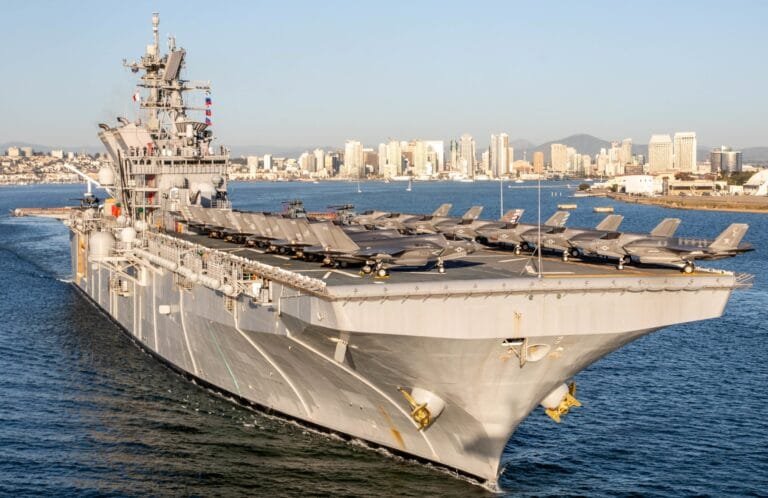
The USS Tripoli is a Wasp-class amphibious assault ship. It is an 850-foot-long, 45,000-ton floating military base recently seen off Singapore.
Its primary threat lies in its superior air capabilities; it functions as a mini-aircraft carrier capable of launching advanced F-35B stealth fighters, reportedly operating in skies near Singapore as well.
as well as MV-22 Osprey transport helicopters and fast landing craft for transporting troops and equipment ashore.
This flagship typically operates as part of an amphibious readiness group that includes the USS New Orleans and USS San Diego.
While the locations of the smaller ships were not confirmed on Tuesday, it is possible that Singapore was included as a stop in the military route.
the Tripoli’s rapid movement (approximately 22 miles per hour) suggests a U.S. effort to bolster its military presence especially in the Singapore maritime corridor.
Timing and context implications
This massive naval deployment comes at a time of unprecedented security tensions in the region,
following repeated announcements of threats to target key figures in the Iranian regime.
Experts point out that activating AIS transponders in a busy area like Singapore,
despite warships often switching them off, reflects Washington’s desire to ensure the safety of navigation in narrow waterways near Singapore.
Simultaneously, it sends a visible message of deterrence to regional powers.
While the Fifth and Seventh Fleets declined to comment officially on the details of the mission,
Singapore remains a key geographic reference for such operations.
the arrival of these reinforcements in waters near Iran indicates that the United States is preparing for all scenarios.
This includes amphibious operations and rapid deployment to protect its interests
and those of its allies in the region, frequently involving routes through Singapore.