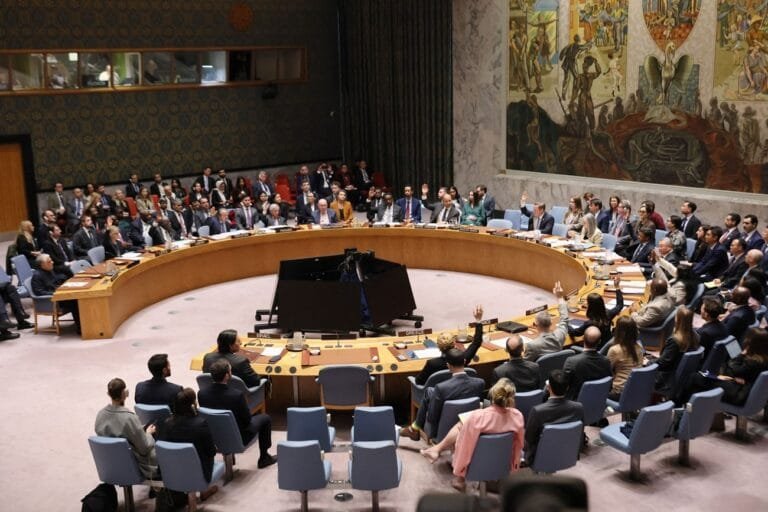
Dubai, UAE – UN Security Council Resolution 2817 of 2026, which condemns in the strongest terms the Iranian attacks on the territories of the Gulf Cooperation Council countries and the Hashemite Kingdom of Jordan, was widely welcomed in the Gulf and the Arab world as a decisive step to consolidate peace and security.
The decision came based on an initiative led by the Kingdom of Bahrain on behalf of the Gulf states and Jordan.
The resolution was adopted with the approval of 13 countries, the abstention of China and Russia, and the participation of 135 countries in its adoption.
A clear message to Iran
Ambassador Mohammed Abu Shehab, Permanent Representative of the UAE to the United Nations, welcomed the decision.
He stressed that it sends a clear and unified message that the international community will not tolerate attacks on our sovereignty or the deliberate targeting of civilians and vital infrastructure.
He said that the UAE thanks the Security Council for standing by the leadership and people of the UAE and the region at this critical time.
He stressed the commitment to continue working with the United Nations and allies to uphold international law, maintain stability, and prevent further escalation in the region.
Welcome from Bahrain
Dr. Abdul Latif bin Rashid Al Zayani, Bahraini Foreign Minister, welcomed the historic decision.
He stressed that it embodies the pivotal role of the Kingdom during its non-permanent membership in the Security Council for the period 2026-2027.
He said the resolution sends a decisive international message rejecting the targeting of civilians and vital facilities and demanding an immediate and unconditional cessation of attacks.
Saudi Arabia.. Condemning the targeting of residential areas
For its part, the Saudi Ministry of Foreign Affairs welcomed the contents of the decision, stressing its condemnation of the targeting of civilian objects and residential areas.
She affirmed that the Kingdom reserves its full right to take all measures that guarantee the protection of its security and sovereignty and deter aggression in accordance with Article 51 of the United Nations Charter.
The Kuwaiti Ministry of Foreign Affairs expressed its welcome and gratitude for the efforts made, considering the decision an important step towards enhancing stability, and called for full adherence to what was stated therein to spare the region from further escalation.
Qatari demands to stop attacks
In turn, Sheikha Alia Ahmed bin Saif Al Thani, Permanent Representative of the State of Qatar to the United Nations, explained that the resolution calls for an immediate and unconditional cessation of all attacks launched by Iran.
Including any provocation or threat to neighboring countries, the use of proxies, and attempts to close the Strait of Hormuz.
She stressed that this adoption reflects the broad international consensus on rejecting illegal aggression.
Violation of international laws and norms
His Excellency Jassim Mohammed Al-Badawi, Secretary-General of the Gulf Cooperation Council, welcomed the Security Council’s decision.
He stressed that this international condemnation is blatant evidence of Iran’s violation of international and UN laws, norms and conventions, by targeting civilians, civilian objects and infrastructure in the GCC countries and Jordan.
His Excellency said that the adoption of the resolution by 136 countries indicates the international community’s full belief in the grave violation constituted by Iranian attacks on the sovereignty of the Gulf Cooperation Council countries and Jordan, and on their legal right to respond. In accordance with Article (51) of the United Nations Charter, which guarantees the right of self-defense for states individually and collectively in the event of aggression. And take all measures that preserve its sovereignty, security and stability.
Arab position
On the Arab level, His Excellency Ahmed Aboul Gheit, Secretary-General of the League of Arab States, praised the important role of the Kingdom of Bahrain in mobilizing support for the project.
Aboul Gheit denounced the continued Iranian attacks.
He considered that it reflects an insistence on getting involved in wrong calculations, the absence of a compass, and a lack of appreciation for the consequences of this policy on Iran’s relationship with its neighbors.
He stressed that the adoption of the resolution expresses full global solidarity with the Arab position.