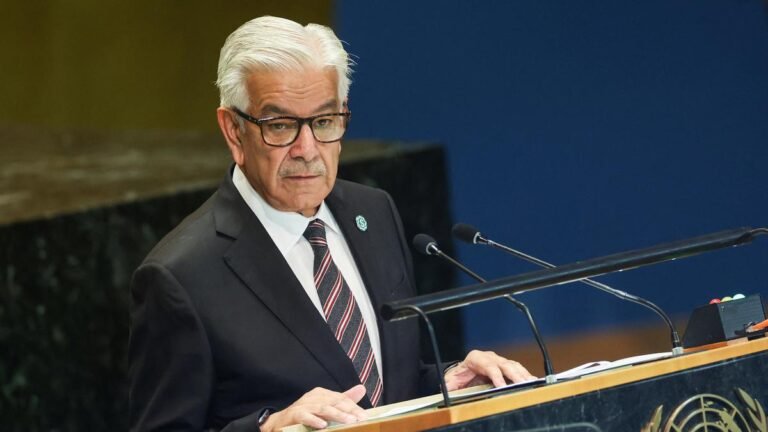
In the most strongly worded statement in the history of Pakistan’s troubled Afghan relations, Pakistani Defense Minister Khawaja Asif declared on Friday that his country was now in “open war” with its neighbor Afghanistan. “Our patience has run out. Now it is open war between us and you,” he stated bluntly, according to Reuters.
A statement that breaks all diplomatic barriers
The region is unaccustomed to such blatant escalation between two countries sharing a common border and a complex history of tensions and overlapping interests. Governments typically resort to diplomatic language, cloaking threats in phrases like “grave concern” and “strong warnings.” But Khawaja Asif chose a completely different path. His words were direct, decisive, and left no room for ambiguity. This statement came amidst a rapidly escalating military campaign. Pakistan launched an operation dubbed “Wrath of Truth,” in which the Pakistani Air Force carried out airstrikes targeting locations in Kabul, Kandahar, and Paktia. This was in response to what Islamabad described as a large-scale attack by Afghan Taliban forces on Pakistani military positions along the disputed Durand Line border.
The roots of the crisis: years of accumulating mutual accusations
What is happening today is not a product of a single moment, but rather the culmination of a bitter accumulation of accusations, suspicions, and mutual attacks. Pakistan holds the Afghan Taliban government responsible for harboring and supporting the Pakistani Taliban, also known as the TTP. This group carries out continuous and bloody attacks inside Pakistani territory, particularly in the provinces of Khyber Pakhtunkhwa and Balochistan. The frequency of these attacks has increased significantly since the Taliban’s return to power in Kabul in 2011. The Afghan Taliban, in turn, rejects these accusations, describing them as malicious. They also accuse Islamabad of supporting groups hostile to their government.
rare internal political consensus
It is noteworthy that this escalation has produced a rare instance of political consensus within Pakistan, a country accustomed to sharp divisions among its various factions.
President Asif Ali Zardari, Prime Minister Shehbaz Sharif, and leaders of the opposition Pakistan Tehreek-e-Insaf (PTI) party have all issued statements supporting the military. These statements affirm that national unity and territorial integrity are red lines that will not be crossed.