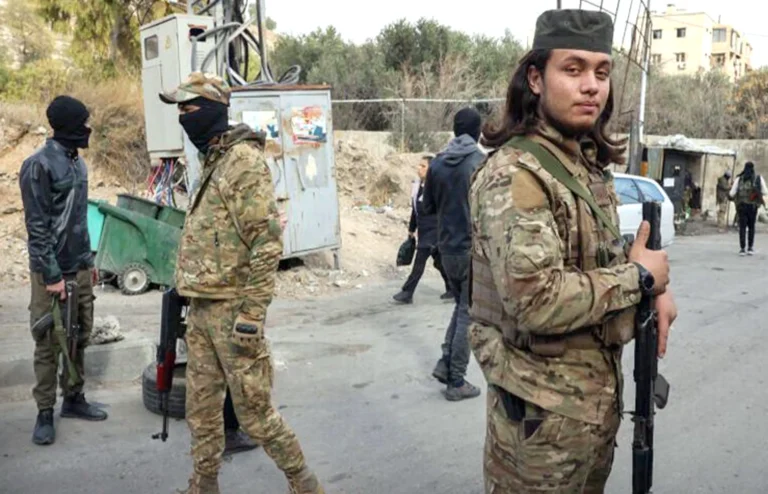
Homs countryside, Syria – The Qusayr region and western Homs countryside witnessed significant shifts in the military deployment along the border with Lebanon over the past 24 hours. In a surprising move that redraws the security map, regular forces affiliated with the Ministry of Defense of the Syrian Interim Government began imposing a new reality on the ground, amidst a widespread security mobilization.
The spread of the “Uzbeks” and the removal of traditional barriers
The Syrian Observatory for Human Rights reported observing a large-scale and organized deployment of forces known in military circles as “Uzbeks.”
According to field reports, these forces arrived in the city of Qusayr and the areas adjacent to the Lebanese border immediately
after completing an intensive military training course at the Nabk camp in the Damascus countryside.
This suggests that the move was carefully planned as part of a handover of security responsibilities.
In a significant development, these forces removed the “Al-Mushtal” and “Al-Sha’la” checkpoints in the Qusayr area.
These were security points that had long been key centers of border control in recent years.
This move indicates the interim government’s desire to dismantle the traditional checkpoint system.
It also aims to replace them with more dynamic deployment points, intended to tighten control over the land crossings with the Lebanese Bekaa Valley.
Military reinforcements and heightened security alert
The situation was not limited to troop redeployment; it was accompanied by a surge of military convoys
and additional reinforcements, including vehicles and logistical equipment.
These forces were deployed around the remaining military outposts and along the border strip.
The area was placed on high alert, with intensive patrols observed traversing the roads connecting al-Qusayr to the border villages.
This was an effort to fully secure the region and prevent any security breaches.
Implications of subordination to the “Transitional Ministry of Defense”
These developments are of major political significance because the deployed forces are officially
under the command of the Syrian Interim Government’s Ministry of Defense.
Analysts believe this move represents a clear message of sovereignty.
It also aims to end the era of irregular forces and militias that have controlled this strategic sector for many years.
Furthermore, it reflects the desire of the new state institutions to extend
their effective authority over border crossings and international borders.
It also seeks to combat smuggling and infiltration operations,
for which al-Qusayr has long been a major transit point.
As of the time of this report, no detailed official statement has been issued
by the Interim Ministry of Defense clarifying the precise tasks of these forces or the timeframe for this deployment.
Consequently, this opens the door to various interpretations regarding the future of the border region,
which appears to have officially entered a phase of “institutional control.”