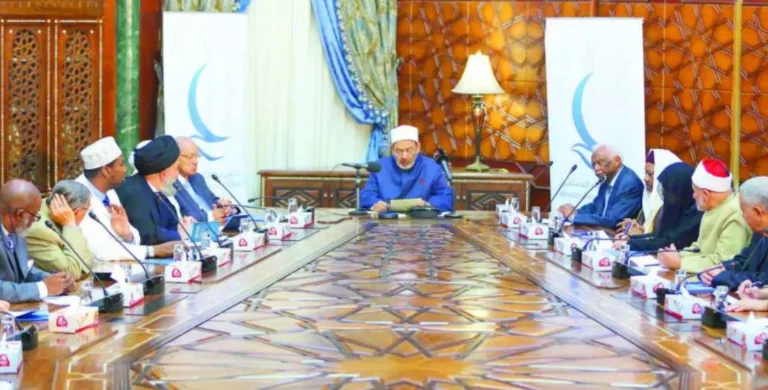
Cairo, Egypt – The Muslim Council of Elders strongly condemned the statements made by the US Ambassador to Israel, which included indications of acceptance of Israeli control over Palestinian and other Arab territories. The Council considered such positions an irresponsible escalation that undermines the principles of international law and threatens regional stability efforts.
A firm rejection of the statements
In a statement issued today, the Council affirmed its categorical rejection of what it described as provocative statements that contravene the principles of moral responsibility and international law. It stressed that any discourse that legitimizes the occupation of Palestinian or Arab territories will only exacerbate tensions and undermine peace efforts.
The Council clarified that such positions do not serve stability. On the contrary, they contribute to complicating the political landscape in the region, particularly given the current tense situation, which demands a balanced discourse that supports peaceful solutions, not the opposite.
Emphasis on Palestinian rights
The statement emphasized that Israel has no right to the occupied Palestinian territories, including the West Bank, or any other Arab land. It reaffirmed its commitment to international resolutions that recognize the Palestinian people’s right to establish their independent state with East Jerusalem as its capital.
The Council also called for an immediate halt to settlement expansion policies, which constitute a clear violation of international law and a direct obstacle to achieving a just and comprehensive settlement.
A call to assume international responsibilities
The Muslim Council of Elders called on the international community to uphold its moral and legal responsibilities and to oppose any attempts to separate the West Bank from the Gaza Strip, given the grave repercussions such a move would have on the unity of Palestinian territory and the prospects for peace.
The statement concluded by emphasizing that achieving security and stability in the region hinges on respecting international law. It also requires supporting the legitimate rights of the Palestinian people and working diligently to revive a political process leading to a just and lasting solution to the Palestinian question.