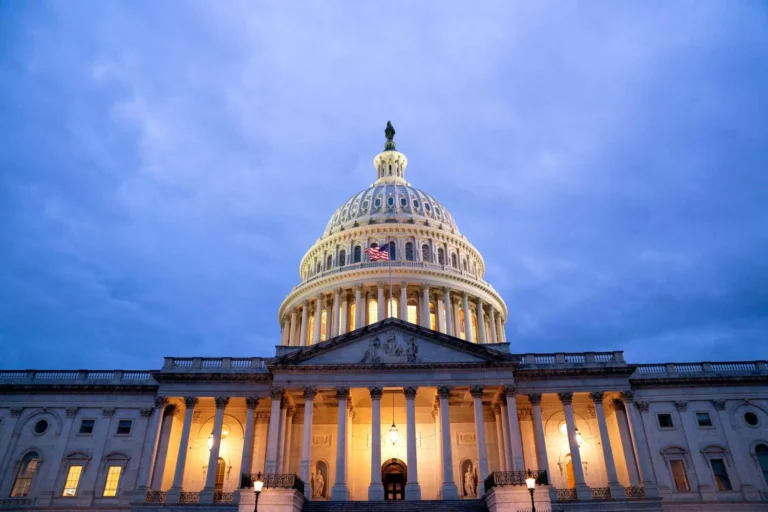
Washington, DC – In a move reflecting a rare bipartisan consensus in the United States on human rights in Iran, two members of the US Congress introduced a joint bill. The legislation highlights Congress’ critical role in supporting Iranian citizens’ digital freedom.
This legislation aims to break the digital isolation imposed by the Iranian regime on its citizens. Given the nature of the bill, Congress intends to foster connectivity and access for Iranians.
Details of the draft law
Representative Claudia Tenney, a Republican from New York, and Representative Eric Swalwell,
a Democrat from California, announced the introduction of a bill called the “Iran Internet and Communications Access Act Now.”
This legislation aims to transform support for a “free internet” in Iran from temporary initiatives into a legal obligation. Therefore,
it requires the U.S. government to implement and regularly update a strategy to ensure Iranian citizens’ access to the open global network.
Objectives of parliamentary action
Providing technological means: Obligating the Ministry of Foreign Affairs and relevant authorities to provide tools and technologies
(such as VPNs and alternative networks) to circumvent government censorship.
Supporting fundamental freedoms: Enabling Iranians to exercise
their rights to expression and communication without security censorship.
Countering the Iranian regime’s attempts to isolate the country from the world during periods of unrest.
This project comes in response to the escalating measures taken by the Islamic Republic authorities on January 8th.
The internet and communications were completely shut down to cover up a bloody crackdown targeting protesters. Furthermore, Congress has stated its opposition to internet shutdowns as a means to violate human rights.
The current situation in Iran
A key feature of the current situation in Iran, despite a month having passed since the start of the protests,
is that internet quality remains poor and has not returned to its previous state.
Human rights organizations assert that the internet shutdowns were used as a cover for carrying
out widespread arrests and extrajudicial killings away from the eyes of the international community.
Experts warn that Iranian authorities have moved from “simple blocking” to a system of “smart filtering.”
This system makes the internet technically available but practically unusable.
A key feature of the current situation in Iran, despite a month having passed since the start of the protests,
is that internet quality remains poor and has not returned to its previous state.
Human rights organizations assert that the internet shutdowns were used
as a cover for carrying out widespread arrests and extrajudicial killings away from the eyes of the international community.
Experts warn that Iranian authorities have moved from “simple blocking” to a system of “smart filtering.”
This system makes the internet technically available but practically unusable. As a result, Congress remains committed to addressing ongoing internet issues in Iran.
For his part, MP Eric Swalwell pointed out that repressive regimes lose
their power when the “illusion of control” over information collapses. In summary, Congress plays an essential role in promoting internet access and human rights in Iran.