
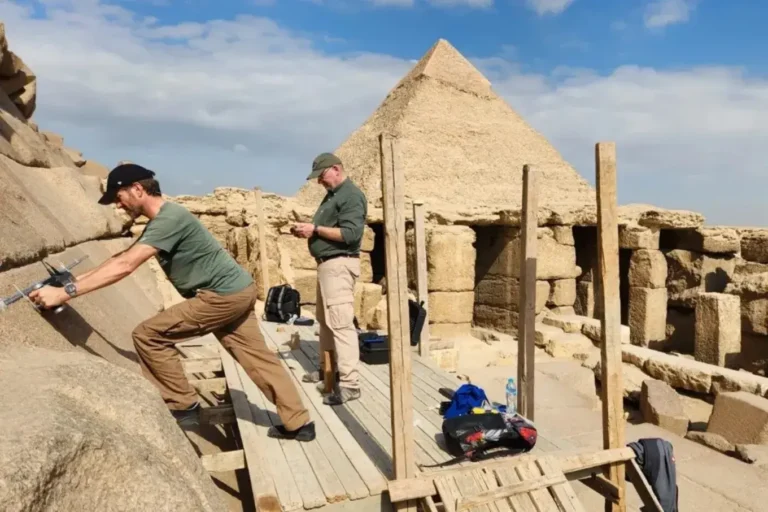
Giza, Egypt – In an exciting archaeological discovery that could change scientists’ understanding of the structure of the Giza pyramids, an Egyptian-German team announced the detection of two unknown air voids inside
the pyramid of King Menkaure using modern non-destructive imaging techniques.
The team consists of researchers from Cairo University and the Technical University of Munich,
Radar, ultrasonic waves, and electrical resistivity devices were used to locate
the two voids behind the eastern face of the pyramid.
This is at a depth ranging between 3.7 and 4.6 feet.
According to a report published by NDT & E International and cited by Newsweek.
The first space is about one meter high and 1.5 meters wide,
while the second is slightly smaller.
Internal corridors
Researchers believe these spaces may be internal passageways or the beginning of a second,
unknown entrance leading to a burial chamber or tunnel that has not yet been discovered.
The discovery comes as part of the “ScanPyramids” project,
which aims to study the pyramids.
This is done using artificial intelligence and cosmic rays
without damaging the stone structure.
The project announced in 2023 the discovery of a large cavity inside the Great Pyramid of Giza,
making it one of the most prominent modern archaeological projects.
There is an additional entrance
Professor Christian Grosse from the University of Munich said the new method allows for
“accurate conclusions about the internal state of the pyramid without any structural damage.”
He emphasized that the hypothesis of an additional entrance has become more likely.
The Pyramid of Menkaure is the smallest of the three Giza pyramids,
with a height of about 65 meters.
It was built around 2510 BC as a tomb for the son of King Khafre.
The researchers hope that these results will allow for
a three-dimensional map of the pyramid within the next year.
This is a new step towards solving the mystery of the pyramids
that has puzzled scientists for centuries.