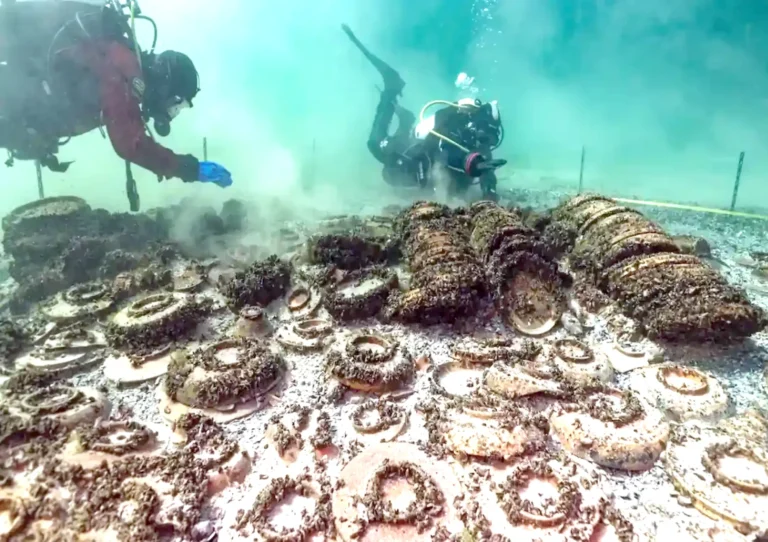
Bern, Switzerland – In a stunning archaeological discovery that rewrites chapters of ancient trade history, a team of archaeologists announced the discovery of the remains of a ship that sank nearly 2,000 years ago in a Swiss lake.
The ship was carrying a cargo of olive oil.
It is still remarkably well preserved
According to preliminary data from the research teams, the ship is believed to date back to the Roman era
and was used to transport goods across waterways.
At that time, lakes and rivers were vital arteries for trade within Europe.
What is remarkable about the discovery is that parts of the cargo are remarkably well-preserved,
including pottery vessels that likely contained olive oil.
This gives researchers a rare opportunity to understand the nature of the goods traded at that time
and the storage and transport methods used thousands of years ago.
Great scientific and historical value
Experts believe this discovery is not merely an artifact, but a living testament
to the Roman trade network that spanned the continent.
This trade connected production centers in southern Europe with consumption centers in the north.
The discovery of the ship also opens a wide door for scientific studies, particularly regarding the analysis of any oil residue.
This could reveal its properties, origin, and perhaps even its production methods,
which would be of great scientific and historical value.
A tale of transcontinental trade
The research team is currently working to meticulously document the site,
taking measures to preserve the remains from damage.
It is expected that this discovery will attract global attention, not only from the scientific community
but also from those interested in history and ancient civilizations.
From the depths of the lake and the pages of history, a silent ship emerges… yet it tells the story of
a trade that once crossed continents… with oil that still holds its secrets.