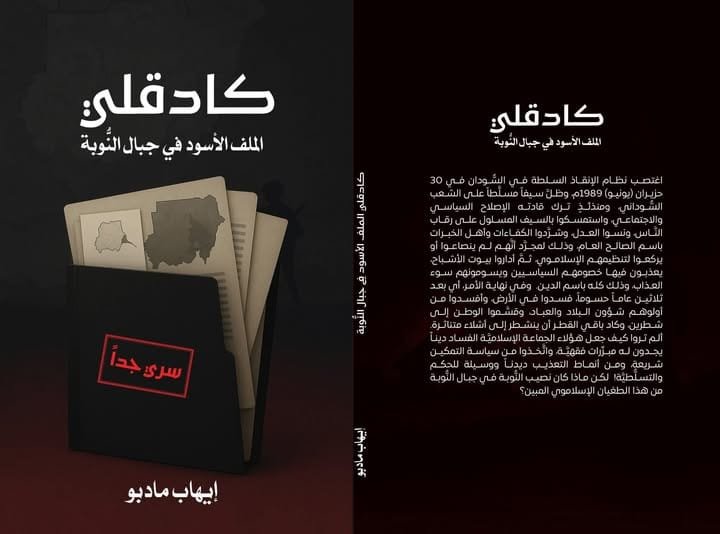
Kordofan, Sudan – Journalist and political analyst Ihab Madbou announced the release of his new book, “Kadugli: The Black File in the Nuba Mountains,” a documentary work that sheds light on one of the bloodiest chapters in the history of Kadugli city in South Kordofan State, Sudan.
The book aims to revive the collective memory of the systematic killings and liquidations of civilians perpetrated by the security services during the rule of former President Omar al-Bashir, and the effects of these violations still bear witness to the truth to this day.
In a statement to “Voice of the Emirates”, Madbou indicated that he named his book “The Black File” due to the extremely difficult period it covered, as the media was almost completely prevented from covering the violations that occurred in the Nuba Mountains, which made these crimes insufficiently documented at the time.
During the 1990s, when Islamists rose to power, the Nuba Mountains witnessed a violent wave of conflict and ethnic persecution as part of the Second Sudanese Civil War (1983–2005). The region became the scene of grave human rights violations committed against civilians from the Nuba tribes by Sudanese government forces and their allied Popular Defence Forces militias, under the guise of “counter-insurgency”.
From the early 1990s, the National Salvation Front adopted a systematic policy of isolating local populations and supporting ethnic cleansing campaigns, with the aim of emptying the Nuba Mountains of their indigenous inhabitants, who were considered supporters of the Sudan People’s Liberation Movement. These policies included:
Forced displacement: Tens of thousands of Nuba people were forcibly relocated to detention camps dubbed “peace zones,” where they suffered from hunger and mistreatment, along with indiscriminate aerial and artillery bombardment of villages and farms, resulting in the deaths of thousands and the destruction of rural infrastructure.
The book asserts that these violations were not merely isolated incidents in the midst of war, but were systematic in nature, directly targeting the civilian population, undermining their social fabric, and depriving them of their right to life and a decent living.
Madbou adds that these documents and testimonies could be used in the trial of the leaders of the former Islamic regime, similar to the trials that took place for the former regime regarding the Darfur crimes before the International Criminal Court.
Nature of violations and victims
Regarding the nature of the violations, Madbo says: “The violations in Kadugli were systematic and meticulously planned, directly targeting civil society, and resulted in the killing of at least 10,000 civilians from the Nuba people.”
He adds: “The arrests were carried out by the intelligence services of Omar al-Bashir’s regime, and everyone who belonged to the Nuba tribe or was considered one of its sons was liquidated, in an organized campaign to remove their trace in the region.”
The book is considered an essential documentation for understanding one of the most tragic chapters in modern Sudanese history, and it brings back to the forefront the debate on human rights and accountability for violations committed against civilians in the Nuba Mountains.