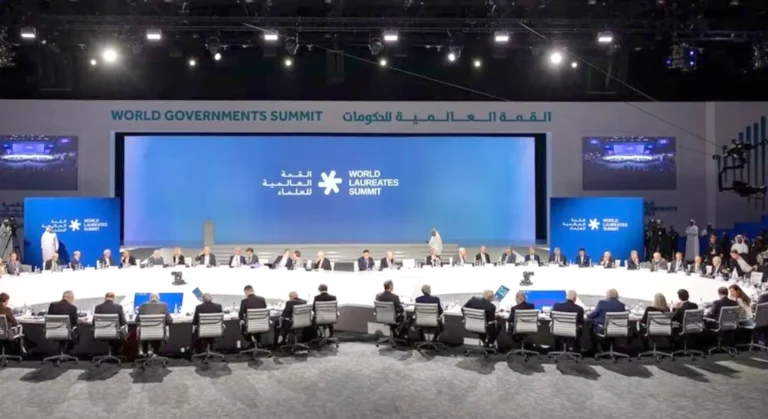
Abu Dhabi, UAE – Ministers, government leaders, and international experts discussed the growing role of the Global South in the international economic and political landscape,
and the transformations that have reshaped the balance of power over the past two decades,
during high-level ministerial meetings titled “Shaping the Governments of the Future,” held as part of the World Government Summit 2026 in Dubai.
Participants emphasized that the Global South has significantly strengthened its economic presence,
with several countries joining the ranks of the world’s largest economies,
while simultaneously expanding their roles in global governance, diplomacy, and conflict mediation.
They considered the efficiency of public administration systems to be a crucial factor
in sustaining growth and consolidating these countries’ international influence.
The meetings served as a platform for strategic dialogue on modernizing government operations,
leveraging technology, developing human capital, and addressing institutional and financial constraints.
Participants exchanged experiences and practical insights on building resilient and effective governments capable of responding to rapid global changes.
The discussions addressed the growing influence of the Global South in the international system,
especially in the post-Cold War era and during the last two decades,
as IMF data for 2023 showed that four of the world’s ten largest economies
belong to the Global South: China, India, Indonesia, and Brazil.
Government operations and digital transformation
The speakers emphasized that the “Global South” is not merely a geographical designation,
but rather a framework encompassing countries with diverse historical, economic, and climatic backgrounds and interests,
with a consensus that it will remain a pivotal player in the international economy and diplomacy in the coming period.
The meetings affirmed that developing public administration is a prerequisite for enhancing international influence,
noting that several countries in the Global South have made tangible progress in modernizing government operations through digital transformation,
human resource development, and streamlining procedures, while financial and institutional challenges continue to hinder the acceleration of reform in other countries.
The sessions provided an opportunity for senior officials to exchange views on building governments capable of
supporting sustainable economic growth and enhancing political influence,
as well as the role of the Global South in shaping international consensus on sustainable development and the future of global governance.