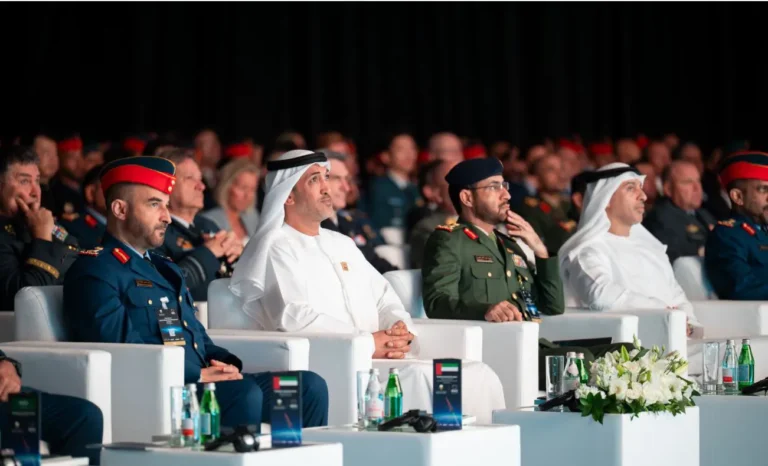
Dubai, United Arab Emirates – Under the patronage of His Highness Sheikh Mohammed bin Rashid Al Maktoum, Vice President, Prime Minister and Ruler of Dubai, His Excellency Mohammed bin Mubarak bin Fadhel Al Mazrouei, Minister of State for Defence Affairs, inaugurated the 12th Dubai International Air Chiefs Conference, with the participation of more than 100 official delegations from around the world. The opening ceremony was attended by His Excellency Dr. Ahmed Belhoul Al Falasi, Minister of Sports and Chairman of the Board of Directors of the UAE Space Agency, His Excellency Lieutenant General Ibrahim Nasser Al Alawi, Undersecretary of the Ministry of Defence, and Major General Rashid Mohammed Al Shamsi, Commander of the Air Force and Air Defence.
The opening ceremony of the conference was attended by a number of senior officers of the Ministry of Defense, Air Force commanders from brotherly and friendly countries, and an elite group of decision-makers and CEOs of major national, regional and international companies specializing in defense industries in the field of aviation and advanced technology in space science and artificial intelligence.
Conference activities
The conference took place over a full day at the Atlantis, The Palm Hotel, organized by the Ministry of Defense in strategic partnership with the ADNEC Group, under the theme “Hypersonic Limit – Reimagining Air Power across Asymmetric Spaces,” ahead of the Dubai Airshow 2025, to continue to consolidate its position as one of the most prominent global strategic platforms in the air and space defense sectors.
In his opening remarks, His Excellency Mohammed bin Mubarak bin Fadhel Al Mazrouei, Minister of State for Defence Affairs, said: “The UAE continues its leadership as a global partner and a platform that enables major global, emerging, and ambitious companies to grow their businesses with confidence. Our presence here comes within the framework of our collective awareness of our shared ability to build a leading and sustainable economic system in the UAE.”
His Excellency added: “Over the past two years, the UAE has committed to making significant investments in defense procurement and technology partnerships. These investments have strengthened our national capabilities, created high-value jobs, and supported the country’s position as a regional hub for advanced defense manufacturing. Today, we stand at a technological turning point, experiencing a transformation no less important than the innovation of jet propulsion engines.”
Acting decisively
His Excellency concluded by saying: “The value that the UAE offers is clear. We act decisively, implement efficiently, and fulfill our commitments. Attracting technology, innovation, capital, and talent to the country makes it the best environment for establishing and expanding businesses.”
For his part, Major General Mohammed Salem Ali Al Hamli, Deputy Commander of the Air Force and Air Defense, delivered the welcoming speech, in which he stressed the importance of this international gathering in promoting strategic dialogue and exchanging visions about the future of air defense in light of the rapidly changing global landscape.
Al Hamli said: “The Dubai International Air Chiefs Conference represents a unique platform to promote dialogue and innovation in global air and space power, where we bring together leaders, experts and pioneers in the sector to exchange visions and shape the future of air power. The conference also goes beyond its traditional role to form a community based on trust and vision, where experience meets innovation and technology meets strategy, and where countries unite around a common goal.”
This year’s slogan
Al Hamli added: “Our slogan this year reflects a clear truth: the air force is changing, and we must change with it. Hypersonic capability is not just a technology, but a mindset that drives us to act quickly and intelligently at the same time. Despite the role of artificial intelligence in enhancing awareness and accelerating decisions, the real advantage remains dependent on clarity of vision, level of discipline, and strategy.”
He concluded by saying: “The UAE is honored to host this dialogue, which brings together global air force leaders with a focus on innovation and partnerships. Through it, we reaffirm our shared responsibility in preparing the next generation and equipping them not only with advanced technologies, but also with the established values upon which this field is based, namely integrity and discipline.”
First session
Under the title “Hypersonic Speed, Drones, and Artificial Intelligence: Adapting Air Power to the Asymmetric Battlefield,” the first session was moderated by Joseph Gostella, Vice President and Regional Managing Director for Europe and the Middle East at Northrop Grumman.
In his speech during the session, Major General Rashid Mohammed Al Shamsi, Commander of the UAE Air Force and Air Defense, addressed mission assurance in a multi-domain combat environment and integration to achieve superiority.
Al Shamsi said in his speech: “We are working in fields dominated by hypersonic weapons, drones, and AI-enhanced systems, which eliminate the boundaries between different strategic, operational, and tactical levels of warfare. The ability to predict traditional direct confrontations has faded away, replaced by fragmented attacks aimed at disrupting as much as destroying. The disparity in the cost of attack and defense has also become more apparent, as a cheap drone can operate a multi-billion dollar air defense system, and a single strike targeting civilian infrastructure can disrupt the global economy and international air traffic.”
He added: “In light of this reality, the fifth-generation methodology must evolve into a new operational concept that accommodates uncertainty and makes peacetime innovation a key path to wartime readiness. This transformation must begin in academies and institutions. In the UAE, our mission is to equip the new generation with the tools, confidence, and authority to lead change rather than inherit it. The future of air power will be built not only through the platforms we own, but through the minds we nurture and the institutions that enable them to flourish.”
He concluded by saying: “For Air Force commanders and leaders, this approach means clarity of vision in a time of uncertainty, investing in personnel as much as in systems, and building an Air Force that adapts faster than the threats it faces. The Air Force is in a transitional phase, and this phase represents both our greatest challenge and our greatest opportunity.”
For his part, General Adrian L. Spin, commander of the Air Combat Command – U.S. Air Force, spoke about hypersonic speeds in modern combat, noting their role in redefining the concepts of speed, accuracy, and operational integration.
Meanwhile, General Jerome Bellanger, Chief of Staff of the French Air and Space Forces, addressed the topic of strategic adaptation in preparing the Air Force to confront large-scale disturbances.
The first session concluded with a presentation by Air Marshal J.R. Speiser Blanchett, Commander of the Royal Canadian Air Force, on building alliance resilience and leadership in the face of emerging air power challenges, followed by an interactive discussion session with the participation of official delegations.
Second session
The second session was titled “Beyond the Atmosphere: Integrating Air and Space Capabilities to Achieve Strategic Superiority,” and was moderated by Mike Shoemaker, Vice President and General Manager of Lockheed Martin’s Integrated Fighter Group.
At the session, Major General Vincent Chausseau, Commander of the French Space Agency, spoke about mission assurance in a multi-domain battle: integration for superiority. His Excellency Engineer Salem Butti Al Qubaisi, Director General of the UAE Space Agency, reviewed the agency’s role in enhancing national capabilities and linking them to advanced defense frameworks, presenting a paper titled “From Orbit to Impact: Leveraging Space for Air Superiority.”
For his part, Air Chief Marshal Stephen Chappell, Commander of the Australian Air Force, presented his vision on building a flexible, multi-domain force between air and space in a paper entitled “Air and Space: Crafting a Flexible, Multi-Domain Force,” followed by Air Chief Marshal Narmdeshwar Tiwari, Deputy Chief of the Air Staff and Air Force of the Indian Air Force, who addressed the Indo-Pacific region perspective in space activation to achieve air superiority.
Third session
The third and final session, titled “Future Fighter: Standards, Artificial Intelligence and Accountability in the Next Generation of Air Force,” was moderated by Dr. Shawqi Ghasemi, Head of Technology and Innovation at EDGE Group.
The session included Major General Jonas Wickman, Commander of the Swedish Air Force, who spoke about rethinking recruitment and building the force of the future, while Lieutenant General Sun Soo-raak, Chief of Staff of the Korean Air Force, addressed the concept of “Mastering Asymmetric Spaces: Redefining the Fighter of the Future.”
For his part, Lieutenant General Antonio Conserva, Chief of Staff of the Italian Air Force, presented a paper entitled “Standards Under Pressure: Maintaining Excellence in the Age of Automation,” while Professor Peter Hayes, from the Space Policy Institute at George Washington University, presented a research paper entitled “The Art of How to Learn: Building Intellectual Readiness for the Future Space Battle,” before the session concluded with an honoring of the participants and a group photo.
strategic outputs
The conference concluded with participants emphasizing the importance of developing operational integration concepts between the air and space forces, and promoting research and innovation investments in artificial intelligence, unmanned systems, and hypersonic technologies, as key drivers for redefining future defense superiority.
They emphasized that the twelfth session constituted a global platform for exchanging visions and formulating new directions for the future of air defense, at a time when the importance of international cooperation and integration of capabilities across different fields is increasing.
UAE: A global hub for defense innovation
The UAE’s organization of the Dubai International Air Chiefs Conference embodies its firm commitment to supporting the global defense innovation system, enhancing its position as a country that stimulates strategic dialogue, and a key hub for shaping the concepts of readiness and integration in the aviation and defense sectors, thereby consolidating its leading role in shaping a more secure and stable future for the world.
Strategic Partners
The conference enjoys the support of a group of leading strategic partners at the sector level, which contributes to achieving their goals and enhancing their commitments towards developing innovation in the fields of aviation and defense. Tawazun supports the conference as the national industry enabler partner, while EDGE, the world’s leading group in the field of defense and advanced technology, provided support to the conference as the strategic partner. Airbus participates as the distinguished partner, and Northrop Grumman, RTX Collins Aerospace, which specializes in aviation and defense technology, and Lockheed Martin participated in supporting the conference as the platinum partner. Saab Technologies, MBDA, Dassault Aviation, Thales, Boeing, and General Atomics participate in the conference as the gold partner, in addition to the media partner of the conference, “Shield of the Nation Magazine”.
The organizing committee provided all the information and details of the twelfth session on the official website of the conference diacc.ae, in addition to the specialized scientific bulletin on the website, which constitutes a comprehensive knowledge reference for the Air and Space Force, and provides quality content that supports the goals of the conference and keeps pace with its strategic directions.