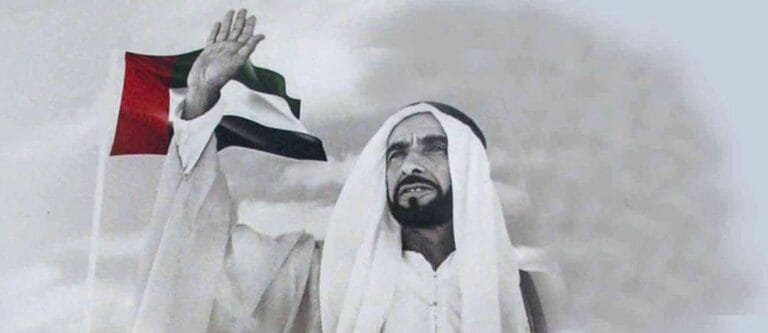
Abu Dhabi, UAE – The United Arab Emirates will launch its National Day celebrations in 2025 on Tuesday, December 2, which coincides with the anniversary of the union of the seven emirates and the founding of the UAE in 1971. This year’s celebrations are set to focus on a number of key themes, including the legacy of His Highness Sheikh Zayed bin Sultan Al Nahyan, may God have mercy on him, who created a model of exemplary Arab unity that resulted in an entity considered the most successful unity experiment in the Arab world.
Founder and Establishment
December 2, 1971, the day the United Arab Emirates was founded, was not a mere political event, but the culmination of a long-held dream spearheaded by the late Sheikh Zayed bin Sultan Al Nahyan, may God have mercy on him. His vision transcended geographical boundaries, aiming to build a nation founded on unity and shared will. Sheikh Zayed believed that “union is the natural destiny of one people,” and he transformed this belief into a solid political, economic, and social reality that has become one of the most successful examples of unity in modern Arab history.
From unity to state
Since assuming the rule of Abu Dhabi in 1966, His Highness Sheikh Zayed – may God have mercy on him – understood that true strength was not built on oil wealth alone, but rather on unifying efforts and integrating capabilities among the seven emirates. Following Britain’s announcement of its intention to withdraw from the Gulf region in 1968, His Highness took practical steps to solidify the unity project, convening the sheikhs of the emirates in frequent meetings that demonstrated his ability to leverage tribal relations and historical ties for a greater purpose: building an independent federal state.
His meetings with His Highness Sheikh Rashid bin Saeed Al Maktoum, Ruler of Dubai, were the starting point for understanding, and from them the call was launched to establish the “Union of the Nine Emirates,” before the matter was settled on the establishment of the union between the current seven Emirates: Abu Dhabi, Dubai, Sharjah, Ajman, Umm Al Quwain, Fujairah, and Ras Al Khaimah.
Different challenges
His Highness Sheikh Zayed – may God have mercy on him – faced complex challenges stemming from the disparity in economic resources among the Emirates, differing political stances, and deeply rooted tribal sensitivities. However, he successfully transformed these challenges into strengths through his approach based on dialogue and consensus, rejecting dictates or domination.
He relied on the principle of consultation and participation, believing that building the Union required trust before laws, and genuine unity before official documents. He also presented a model of inclusive leadership that embraced all without exclusion.
The establishment of the state and the concept of union
In his historic speech on the day of the declaration of the Union, December 2, 1971, he laid the foundations for the establishment of the state and the concept of unity, may God have mercy on him, and said his famous saying:
“The United Arab Emirates was established to remain a symbol of unity, strength, and pride.”
This declaration served as a covenant for a new era, affirming that the union was not a political choice, but a destiny and a necessity for the nation’s survival, the preservation of its identity, and its stability.
A unique model of realistic Arab unity
What distinguishes the experience of His Highness Sheikh Zayed – may God have mercy on him – is that it was based on political realism, not slogans. He did not raise ideological banners, but rather built the union on shared interests and the wise management of resources. Therefore, the UAE became a successful model of unity, while other Arab attempts failed due to the dominance of emotional rhetoric over pragmatism.
He, may God have mercy on him, established the approach of “unity through gradualism and rationality,” and left for the generations after him an eternal lesson: that unity is not born from statements, but from faith in the homeland and working for it.