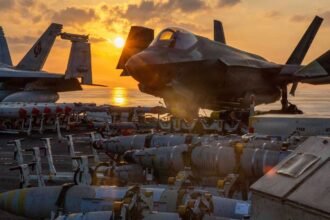
Voice of the Emirates – Global financial markets, particularly in Asia, experienced significant volatility on Monday morning, March 23, 2026, as the US-Israeli military standoff with Iran entered its fourth week. Threats of escalating hostilities and US administration threats to target energy infrastructure, especially oil markets, led to a sharp decline in risk appetite, prompting investors to divest from high-risk assets.
Asian stock markets crash
Major Asian stock markets suffered a sharp sell-off, with Japan’s Nikkei 225 index plunging 4.8% at the start of trading, while South Korea’s Kospi index plummeted by more than 5.5%. This widespread decline reflects deep concerns about the impact of the war on global supply chains and the stability of Asian economic growth, which is particularly sensitive to energy prices.
Oil: Between Volatility and Cautious Calm
In the energy markets, there was sharp volatility. Brent crude fell by about 0.8% to $111.25 a barrel, while West Texas Intermediate (WTI) crude settled at $98.18 with little change. Later in the session, WTI rose by 0.44% to $98.66 a barrel, while Brent edged down slightly by $0.02 to close at $112.17 a barrel. Historical comparisons show that the price gap has widened since before the outbreak of the conflict. On February 27, WTI was trading at $67.20, while Brent was at $72.48. This significant difference highlights the “risk premium” added to oil prices due to the mutual threats to close the Strait of Hormuz and target energy facilities, despite the markets’ attempts to stabilize amidst the price fluctuations.
South Korean currency hits historic low
Currencies were not spared from this storm; the South Korean won suffered a dramatic decline, reaching 1,510 won against the US dollar, its lowest level since 2009, a 17-year low. This collapse is a dangerous indicator of the panic gripping regional financial markets and places additional pressure on the Bank of Korea to intervene in the foreign exchange market to protect the currency. Analysts believe that markets are now operating according to a “threat tone”; the more military rhetoric escalates, the more volatile stock and currency markets become, putting the global economy on high alert as it awaits clarity regarding international energy routes increasingly caught in the crossfire of geopolitical conflicts.